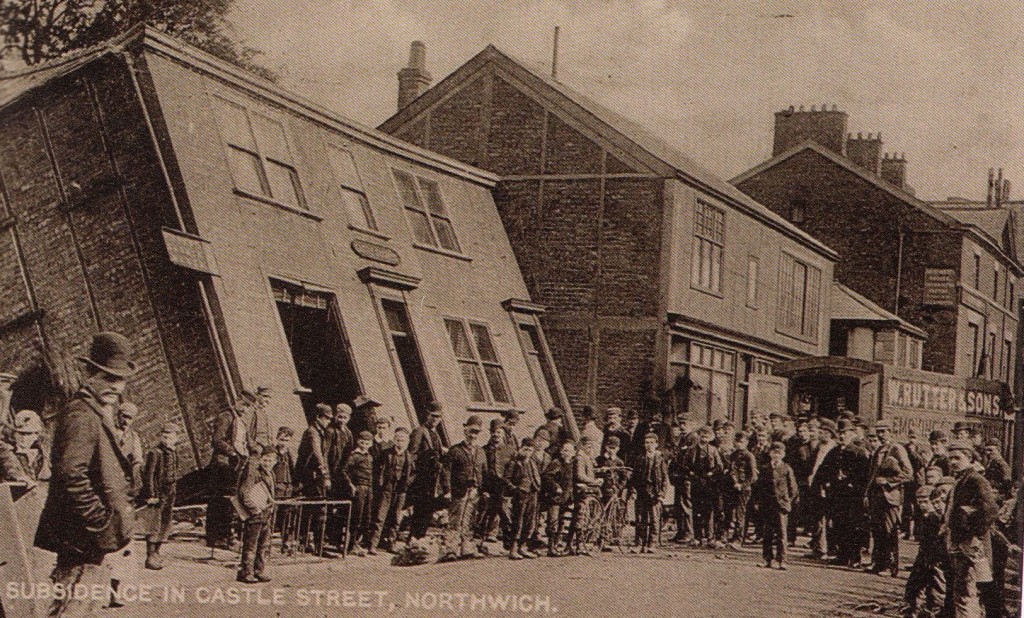
Read for Nature and Environment. It started with a great intro about a chunk of salt from Cardona and its strange behavior on the author’s windowsill. I learned a ton of fascinating things, but it was overall kind of a disappointing hodgepodge. Kurlansky is sometimes confusing, and a few things I looked up turned out to be wrong. He claims that “Ragoût de berniques, literally a stew made of nothing, was in fact made of potatoes, carrots, and onions” but actually it looks like berniques are limpets. He describes Nehemiah Grew as “a British plant physiologist who is credited with being the first human ever to witness and document plants having sex” – a bizarre way to describe proposing a theory of sexual reproduction in plants. The photo of salt subsidence linked below was captioned “in Castle, Cheshire” whereas it’s Castle STREET in Norwich, Cheshire. I was a little shocked that such a thorough researcher would describe sardines as belonging to the Clupeidea family – sardines are not a species but rather any of a set of small fish (i.e. all Clupeidea might be sardines, but not all sardines are Clupeidea). I’m nitpicking, but very glad we read it.
I looked up or learned:
- Kahm yeast
- Oxalme (vinegar brine sauce)
- In Sichuan province, natural gas was being used to boil off brine in AD 200
- Small onions were placed in the eye sockets of the mummy of Ramses the IV
- Tarim mummies
- Cod preserves so well because it has almost no fat in its flesh
- I knew the gabelle was something the French hated that led to the revolution, but I thought it was a work requisition. I didn’t realize it was a tax on salt – also “sel du devoir,” forced purchase of 7 kg of salt per year per person over the age of 8, but you couldn’t use it to make salted products or you’d be charged with “faux saunage,” salt fraud.
- Herring light and/or herring lightning – interesting phenomena around their huge schools
- The Polish national poem, Pan Tadeusz, says “sliced saukraut… just walks into the mouth” (re bigos, the equivalent of choucroute garni)
- “Anglo Saxons called a saltworks a wich, and any place in England where the name ends in ‘wich’ at one time produced salt”
- An incredibly detailed method for curing salmon specifies the barrel “is to be stamped or leaped upon by a youth of about 15 years old or thereabouts”
- Bell metal: bronze with a high tin percentage
- Saltworks near Syracuse had watchtowers with bells to be rung when rain threatened so the workers and their families, who lived nearby, could rush over and pull covers over the vats. “Entire families ran to the saltworks, competing with each other to be first to cover a complete row. Winning families got small cash prizes.”
- Small amounts of nitrates are still allowed for the “oddly unquestioned goal of making ham reddish” (apparently the color was a side effect of the preserving process)
- Early chemistry said “sugar is a salt”
- Birdseye discovered that flash-freezing preserved food better “because of a principle every salt maker knew: Rapid crystallization creates small crystals, and slow crystallization produces large ones.”
- The history of subsidence in Cheshire (great photo from the book) led me to learn about “bastard brine,” which I can’t believe Kurlansky didn’t include!
- The British tried to prevent salt smuggling in India in the 1840s by creating an impenetrable thorn Great Hedge hundreds of miles long
- The Dead Sea was named Asphalt Lake by the Romans and blocks of asphalt can be found floating in it
- The old crest of Turks and Caicos sometimes has a little door drawn on one of the salt piles because “the English designer assumed the little white domes were igloos”
- This is probably true of mines in general: “When equipment is no longer useful, it is not considered cost effective to take it apart and bring it back up, so the mine leaves a trail of abandoned equipment, a junkyard on the side of some of the wide shafts.”
- Liberty Style was the Italian Art Nouveau
- “After thousands of years of struggle to make salt white and of even grain, affluent people will now pay more for salts that are odd shapes and colors”
Acids search for an electron that they lack, and bases try to shed an extra one. Together they make a well-balanced compound, a salt. …
It turned out that salt was a microcosm for one of the oldest concepts of nature and the order of the universe. From the fourth-century-B.C. Chinese belief in the forces of yin and yang, to most of the world’s religions, to modern science, to the basic principles of cooking, there has always been a belief that two opposing forces find completion—one recieving a missing part and the other shedding an extra one. A salt is a small but perfect thing.
As brine boiling was fading, Sichuan engineers found a new use for the natural gas at the wells. Buses were built with giant gray bladders on the roofs, filled with the local natural gas. They started out on their routes with the huge rectangular bladder on top almost as big as the bus. The big bladder swayed and jiggled like Jell-O as the bus rounded corners, and then it gradually deflated, the gray bag sagging from the roof, as the gas was used up. Locals call the buses da qi bao, which means “big bag of gas.” The buses need frequent refueling.
It’s true! Here’s a great photo, and a very informative article on the history of such transport in Low Tech magazine.