The Fortunes and Misfortunes of the Famous Moll Flanders, Etc. – Daniel Defoe, 1722

Forbes Great Books selection. What a fascinating book – we had a great discussion, and it’s one of the most memorable titles we’ve read.

Defoe starts by saying that “there is not a wicked action in any part of it, but is first and last rendered unhappy and unfortunate” but what comes through is the focus on money, on survival, whatever it takes. “I am giving an account of what was, not of what ought or ought not to be.” “The vice came in always at the door of necessity, not at the door of inclination.” Moll’s self-interest makes her emotional responses of guilt wear off quickly. Useful warnings to the reader against being too trusting. It also emphasizes how fabric was so valuable – a bundle of lace was worth 300 pounds in money of the time!

  • “all I understood by being a gentlewoman was to be able to work for myself, and get enough to keep me without that terrible bugbear going to service, whereas they meant to live great, rich and high, and I know not what”
  • Old governess comforting her: “to sink under the Weight, was but to encrease the Weight”
  • Transportation: “we should live as new People in a new World”

it was requisite to a whore to be handsome, well-shaped, have a good mien and a graceful behaviour; but that for a wife, no deformity would shock the fancy, no ill qualities the judgment; the money was the thing; the portion was neither crooked nor monstrous, but the money was always agreeable, whatever the wife was.

I’d love to find out more about this: “A Garbling Office has been established in London in the fifteenth century to inspect several Sorts of Goods, more particularly subject to Frauds, Mixtures and false Package, in order to cleanse them, and make them Merchantable)” (Review, iv 635, 17 Feb 1708)

The Grapes of Wrath – John Steinbeck, 1939

To my surprise, most of us in the Great Books group had never read this before. I particularly loved the amazing descriptions and the poetic interstitial chapters.

In this book I learned

  • anlage – “the foundation of a subsequent development”
  • Rochester lamp

Short quotes

  • “all the various purposes of a cap—carrying sack, towel, handkerchief.”
  • Half-car/half-truck “this was the new hearth, the living center of the family”
  • “You’re jus’ as free as you got jack to pay for it”
  • Poor boys staring at a candy case: “not with craving or with hope or even with desire, but just with a kind of wonder that such things could be”
  • “a furrow four miles long that ain’t stoppin’ or goin’ aroun’ Jesus Christ Hisself”
  • “I never seen nobody that’s busy as a prairie dog collectin’ stuff that wasn’t disappointed”
  • “A red is any son-of-a-bitch that wants thirty cents an hour when we’re payin’ twenty-five!”
  • “the on’y thing you got to look at is that ever’ time they’s a little step fo’ward, she may slip back a little, but she never slips clear back”
  • “Ruthie looked fiercely about, but she went to a corner of the car and put her back in the corner. Her shame and fierceness were blended.”
  • “Every kid got a turtle some time or other. Nobody can’t keep a turtle though. They work at it and work at it, and at last one day they get out and away they go- off somewheres.”
  • Tenant says: “We all got to figure. There’s some way to stop this. It’s not like lightning or earthquakes. We’ve got a bad thing made by men, and by God that’s something we can change.”
  • “The nickel, which has caused all this mechanism to work, has caused Crosby to sing and an orchestra to play- this nickel drops from between the contact points into the box where the profits go. The nickel, unlike most money, has actually done a job of work, has been physically responsible for a reaction.”
  • “‘We pay sales tax an’ gas tax an’ tobacco tax,’ this little guy says. An’ he say, ‘Farmers get four cents a cotton poun’ from the gov’ment- ain’t that relief?’ An’ he says, ‘Railroads an’ shippin’ companies draw subsidies- ain’t that relief?'”

Jim Casy quotes:

“I figgered about the Holy Sperit and the Jesus road. I figgered, ‘Why do we got to hang it on God or Jesus? Maybe,’ I figgered, ‘maybe it’s all men an’ all women we love; maybe that’s the Holy Sperit- the human sperit- the whole shebang. Maybe all men got one big soul ever’body’s a part of.’ Now I sat there thinkin’ it, an’ all of a suddent- I knew it. I knew it so deep down that it was true, and I still know it.”

“I ain’t sayin’ I’m like Jesus,” the preacher went on. “But I got tired like Him, an’ I got mixed up like Him, an’ I went into the wilderness like Him, without no campin’ stuff. Nighttime I’d lay on my back an’ look up at the stars; morning I’d set an’ watch the sun come up; midday I’d look out from a hill at the rollin’ dry country; evenin’ I’d foller the sun down. Sometimes I’d pray like I always done. On’y I couldn’ figure what I was prayin’ to or for. There was the hills, an’ there was me, an’ we wasn’t separate no more. We was one thing. An’ that one thing was holy.”

“This here ol’ man jus’ lived a life an’ jus’ died out of it. I don’t know whether he was good or bad, but that don’t matter much. He was alive, an’ that’s what matters. An’ now he’s dead, an’ that don’t matter. Heard a fella tell a poem one time, an’ he says, ‘All that lives is holy.’ Got to thinkin’, an’ purty soon it means more than the words says. An’ I wouldn’ pray for a ol’ fella that’s dead. He’s awright. He got a job to do, but it’s all laid out for ‘im an’ there’s on’y one way to do it. But us, we got a job to do, an’ they’s a thousan’ ways, an’ we don’ know which one to take. An’ if I was to pray, it’d be for the folks that don’ know which way to turn. Grampa here, he got the easy straight. An’ now cover ‘im up and let ‘im get to his work.”

Tom Joad quoting Casy:

Says one time he went out in the wilderness to find his own soul, an’ he foun’ he didn’ have no soul that was his’n. Says he foun’ he jus’ got a little piece of a great big soul. Says a wilderness ain’t no good, ’cause his little piece of a soul wasn’t no good ‘less it was with the rest, an’ was whole. Funny how I remember. Didn’t even think I was listenin’. But I know now a fella ain’t no good alone.”

“Well, maybe like Casy says, a fella ain’t got a soul of his own, but on’y a piece of a big one — an’ then —”
“Then what, Tom?”
“Then it don’ matter. Then I’ll be all aroun’ in the dark. I’ll be ever’where — wherever you look. Wherever they’s a fight so hungry people can eat, I’ll be there. Wherever they’s a cop beatin’ up a guy, I’ll be there. If Casy knowed, why, I’ll be in the way guys yell when they’re mad an’ — I’ll be in the way kids laugh when they’re hungry an’ they know supper’s ready. An’ when our folks eat the stuff they raise an’ live in the houses they build — why, I’ll be there.

Her hazel eyes seemed to have experienced all possible tragedy and to have mounted pain and suffering like steps into a high calm and a superhuman understanding. She seemed to know, to accept, to welcome her position, the citadel of the family, the strong place that could not be taken. And since old Tom and the children could not know hurt or fear unless she acknowledged hurt and fear, she had practiced denying them in herself. And since, when a joyful thing happened, they looked to see whether joy was on her, it was her habit to build up laughter out of inadequate materials. But better than joy was calm. Imperturbability could be depended upon. And from her great and humble position in the family she had taken dignity and a clean calm beauty. From her position as healer, her hands had grown sure and cool and quiet; from her position as arbiter she had become as remote and faultless in judgment as a goddess. She seemed to know that if she swayed the family shook, and if she ever really deeply wavered or despaired the family would fall, the family will to function would be gone.

Selling horses:

You’re buying a little girl plaiting the forelocks, taking off her hair ribbon to make bows, standing back, head cocked, rubbing the soft noses with her cheek. You’re buying years of work, toil in the sun; you’re buying a sorrow that can’t talk. But watch it, mister. There’s a premium goes with this pile of junk and the bay horses- so beautiful- a packet of bitterness to grow in your house and to flower, some day. We could have saved you, but you cut us down, and soon you will be cut down and there’ll be none of us to save you.

“Ain’t you thinkin’ what’s it gonna be like when we get there? Ain’t you scared it won’t be nice like we thought?”
“No,” she said quickly. “No, I ain’t. You can’t do that. I can’t do that. It’s too much- livin’ too many lives. Up ahead they’s a thousan’ lives we might live, but when it comes, it’ll on’y be one. If I go ahead on all of ’em, it’s too much. You got to live ahead ’cause you’re so young, but- it’s jus’ the road goin’ by for me.

Little pot-bellied men in light suits and panama hats; clean, pink men with puzzled, worried eyes, with restless eyes. Worried because formulas do not work out; hungry for security and yet sensing its disappearance from the earth. In their lapels the insignia of lodges and service clubs, places where they can go and, by a weight of numbers of little worried men, reassure themselves that business is noble and not the curious ritualized thievery they know it is; that business men are intelligent in spite of the records of their stupidity; that they are kind and charitable in spite of the principles of sound business; that their lives are rich instead of the thin tiresome routines they know; and that a time is coming when they will not be afraid any more.

They arose in the dark no more to hear the sleepy birds’ first chittering, and the morning wind around the house while they waited for the first light to go out to the dear acres. These things were lost, and crops were reckoned in dollars, and land was valued by principal plus interest, and crops were bought and sold before they were planted. Then crop failure, drought, and flood were no longer little deaths within life, but simple losses of money. And all their love was thinned with money, and all their fierceness dribbled away in interest until they were no longer farmers at all, but little shopkeepers of crops, little manufacturers who must sell before they can make. Then those farmers who were not good shopkeepers lost their land to good shopkeepers. No matter how clever, how loving a man might be with earth and growing things, he could not survive if he were not also a good shopkeeper. And as time went on, the business men had the farms, and the farms grew larger, but there were fewer of them.

O Pioneers! – Willa Cather, 1913

Great Books selection – we’ve loved every Cather we’ve tried!

I learned about buffalo-pea (Mrs. Bergson tries to make jam of them)

Short quotes

  • “Marie was incapable of being lukewarm about anything that pleased her. She simply did not know how to give a half-hearted response. When she was delighted, she was as likely as not to stand on her tip-toes and clap her hands. If people laughed at her, she laughed with them.”
  • “There was about Alexandra something of the impervious calm of the fatalist, always disconcerting to very young people, who cannot feel that the heart lives at all unless it is still at the mercy of storms; unless its strings can scream to the touch of pain.”
  • Poor Swedish girls marrying men “they are afraid of” because they “think a cross man makes a good manager”
  • Alexandra says about Carl understanding her: “I expect that is the only way one person every really can help another.”
  • Smart young man “raising the new kind of clover. He says the right thing is usually just what everybody don’t do.”
  • “The trouble is you almost have to marry a man before you can find out the sort of wife he needs; and usually it’s exactly the sort you are not.” No-fault divorce would change everything!

Long quotes (so many!)

The little town behind them had vanished as if it had never been, had fallen behind the swell of the prairie, and the stern frozen country received them into its bosom. The homesteads were few and far apart; here and there a windmill gaunt against the sky, a sod house crouching in a hollow. But the great fact was the land itself, which seemed to overwhelm the little beginnings of human society that struggled in its sombre wastes. It was from facing this vast hardness that the boy’s mouth had become so bitter; because he felt that men were too weak to make any mark here, that the land wanted to be let alone, to preserve its own fierce strength, its peculiar, savage kind of beauty, its uninterrupted mournfulness.

The winter twilight was fading. The sick man heard his wife strike a match in the kitchen, and the light of a lamp glimmered through the cracks of the door. It seemed like a light shining far away. He turned painfully in his bed and looked at his white hands, with all the work gone out of them. He was ready to give up, he felt. He did not know how it had come about, but he was quite willing to go deep under his fields and rest, where the plow could not find him. He was tired of making mistakes. He was content to leave the tangle to other hands; he thought of his Alexandra’s strong ones.

At one end of the pond was an earthen dam, planted with green willow bushes, and above it a door and a single window were set into the hillside. You would not have seen them at all but for the reflection of the sunlight upon the four panes of window-glass. And that was all you saw. Not a shed, not a corral, not a well, not even a path broken in the curly grass. But for the piece of rusty stovepipe sticking up through the sod, you could have walked over the roof of Ivar’s dwelling without dreaming that you were near a human habitation. Ivar had lived for three years in the clay bank, without defiling the face of nature any more than the coyote that had lived there before him had done.

Ivar found contentment in the solitude he had sought out for himself. He disliked the litter of human dwellings: the broken food, the bits of broken china, the old wash-boilers and tea-kettles thrown into the sunflower patch. He preferred the cleanness and tidiness of the wild sod. He always said that the badgers had cleaner houses than people, and that when he took a housekeeper her name would be Mrs. Badger. He best expressed his preference for his wild homestead by saying that his Bible seemed truer to him there. If one stood in the doorway of his cave, and looked off at the rough land, the smiling sky, the curly grass white in the hot sunlight; if one listened to the rapturous song of the lark, the drumming of the quail, the burr of the locust against that vast silence, one understood what Ivar meant.

You know that my spells come from God, and that I would not harm any living creature. You believe that every one should worship God in the way revealed to him. But that is not the way of this country. The way here is for all to do alike. I am despised because I do not wear shoes, because I do not cut my hair, and because I have visions. At home, in the old country, there were many like me, who had been touched by God, or who had seen things in the graveyard at night and were different afterward. We thought nothing of it, and let them alone. But here, if a man is different in his feet or in his head, they put him in the asylum.

Contrast between brothers and Alexandra:

The Bergson boys, certainly, would have been happier with their uncle Otto, in the bakery shop in Chicago. Like most of their neighbors, they were meant to follow in paths already marked out for them, not to break trails in a new country. A steady job, a few holidays, nothing to think about, and they would have been very happy. It was no fault of theirs that they had been dragged into the wilderness when they were little boys. A pioneer should have imagination, should be able to enjoy the idea of things more than the things themselves.

Oscar:

But he was as indolent of mind as he was unsparing of his body. His love of routine amounted to a vice. He worked like an insect, always doing the same thing over in the same way, regardless of whether it was best or no. He felt that there was a sovereign virtue in mere bodily toil, and he rather liked to do things in the hardest way. If a field had once been in corn, he couldn’t bear to put it into wheat. He liked to begin his corn-planting at the same time every year, whether the season were backward or forward. He seemed to feel that by his own irreproachable regularity he would clear himself of blame and reprove the weather. When the wheat crop failed, he threshed the straw at a dead loss to demonstrate how little grain there was, and thus prove his case against Providence.

The table was set for company in the dining-room, where highly varnished wood and colored glass and useless pieces of china were conspicuous enough to satisfy the standards of the new prosperity. Alexandra had put herself into the hands of the Hanover furniture dealer, and he had conscientiously done his best to make her dining-room look like his display window. She said frankly that she knew nothing about such things, and she was willing to be governed by the general conviction that the more useless and utterly unusable objects were, the greater their virtue as ornament. That seemed reasonable enough. Since she liked plain things herself, it was all the more necessary to have jars and punchbowls and candlesticks in the company rooms for people who did appreciate them. Her guests liked to see about them these reassuring emblems of prosperity.

Carl:

“Freedom so often means that one isn’t needed anywhere. Here you are an individual, you have a background of your own, you would be missed. But off there in the cities there are thousands of rolling stones like me. We are all alike; we have no ties, we know nobody, we own nothing. When one of us dies, they scarcely know where to bury him.

Remembering Alexandra:

He could remember exactly how she looked when she came over the close-cropped grass, her skirts pinned up, her head bare, a bright tin pail in either hand, and the milky light of the early morning all about her. Even as a boy he used to feel,  when he saw her coming with her free step, her upright head and calm shoulders, that she looked as if she had walked straight out of the morning itself. Since then, when he had happened to see the sun come up in the country or on the water, he had often remembered the young Swedish girl and her milking pails.

Alexandra and Emil’s wild duck:

In this little bay a single wild duck was swimming and diving and preening her feathers, disporting herself very happily in the flickering light and shade. They sat for a long time, watching the solitary bird take its pleasure. No living thing had ever seemed to Alexandra as beautiful as that wild duck. Emil must have felt about it as she did, for afterward, when they were at home, he used sometimes to say, “Sister, you know our duck down there—” Alexandra remembered that day as one of the happiest in her life. Years afterward she thought of the duck as still there, swimming and diving all by herself in the sunlight, a kind of enchanted bird that did not know age or change.

As he rode past the graveyard he looked at the brown hole in the earth where Amedee was to lie, and felt no horror. That, too, was beautiful, that simple doorway into forgetfulness. The heart, when it is too much alive, aches for that brown earth, and ecstasy has no fear of death. It is the old and the poor and the maimed who shrink from that brown hole; its wooers are found among the young, the passionate, the gallant-hearted.

When Frank took up his gun and walked out of the house, he had not the faintest purpose of doing anything with it. He did not believe that he had any real grievance. But it gratified him to feel like a desperate man. He had got into the habit of seeing himself always in desperate straits. His unhappy temperament was like a cage; he could never get out of it; and he felt that other people, his wife in particular, must have put him there. It had never more than dimly occurred to Frank that he made his own unhappiness. Though he took up his gun with dark projects in his mind, he would have been paralyzed with fright had he known that there was the slightest probability of his ever carrying any of them out.

He knew that he was to blame. For three years he had been trying to break her spirit. She had a way of making the best of things that seemed to him a sentimental affectation. He wanted his wife to resent that he was wasting his best years among these stupid and unappreciative people; but she had seemed to find the people quite good enough. If he ever got rich he meant to buy her pretty clothes and take her to California in a Pullman car, and treat her like a lady; but in the mean time he wanted her to feel that life was as ugly and as unjust as he felt it. He had tried to make her life ugly. He had refused to share any of the little pleasures she was so plucky about making for herself. She could be gay about the least thing in the world; but she must be gay!

Death in Venice – Thomas Mann, 1924

Another Great Books selection I had always wanted to read, and wow, it is indeed amazing. I tried a couple of translations: Kenneth Burke’s and H. T. Lowe-Porter’s. I noted some interesting differences:

  • Burke translates “schwermütig-enthusiastischen Dichters” as “the heavy-hearted, enthusiastic poet,” which HTLP has as “melancholy and susceptible” (apparently the poet referred to is August von Platen-Hallermünde).
  • In Aschenbach’s dream of ancient rites, Burke uses “the foreign god” vs HTLP’s “the stranger god.”

And one of the most haunting passages, after Aschenbach visits the barber:

  • Burke: “It was raining sparsely and at intervals, but the air was damp, thick, and filled with the smell of things rotting. All around him he heard a fluttering, pattering, and swishing; and under the fever of his cosmetics it seemed to him as though evil wind-spirits were haunting the place, impure seabirds which rooted and gnawed at the food of the condemned and befouled it with their droppings. For the sultriness destroyed his appetite, and the fancy suggested itself that the foods were poisoned with contaminating substances.”
  • HTLP: “It rained a little now and then, the air was heavy and turbid and smelt of decay. Aschenbach, with fevered cheeks beneath the rouge, seemed to hear rushing and flapping sounds in his ears, as though storm-spirits were abroad—unhallowed ocean harpies who follow those devoted to destruction, snatch away and defile their viands. For the heat took away his appetite and thus he was haunted with the idea that his food was infected.”

Other quotes

  • Aschenbach’s longing to travel: “Desire projected itself visually: his fancy, not quite yet lulled since morning, imagined the marvels and terrors of the manifold earth. He saw. He beheld a landscape, a tropical marshland…”
  • “His love of the ocean had profound sources: the hard-worked artist’s longing for rest, his yearning to seek refuge from the thronging manifold shapes of his fancy in the bosom of the simple and vast; and another yearning, opposed to his art and perhaps for that very reason a lure, for the unorganized, the immeasurable, the eternal—in short, for nothingness. He whose preoccupation is with excellence yearns fervently to find rest in perfection; and is not nothingness a form of perfection?”
  • Keeping the epidemic a secret: “So Aschenbach felt a dark contentment with what was taking place, under cover of the authorities, in the dirty alleys of Venice. This wicked secret of the city was welded with his own secret, and he too was involved in keeping it hidden.”

The Fire Next Time – James Baldwin, 1963

This was a Great Books selection that most everyone thought highly of, and which led to a great discussion. I want to read it again more slowly – it was so good.

Short quotes

  • “For these innocent people [white people] have no other hope. They are, in effect, still trapped in a history which they do not understand; and until they understand it, they cannot be released from it.”
  • “For this is your home, my friend, do not be driven from it; great men have done great things here, and will again, and we can make America what America must become.”
  • “But the Negro’s experience of the white world cannot possibly create in him any respect for the standards by which the white world claims to live. His own condition is overwhelming proof that white people do not live by these standards.”
  • “When I watched all the children, their copper, brown, and beige faces staring up at me as I taught Sunday school, I felt that I was committing a crime in talking about the gentle Jesus, in telling them to reconcile themselves to their misery on earth in order to gain the crown of eternal life. Were only Negroes to gain this crown? Was Heaven, then, to be merely another ghetto?”
  • “If the concept of God has any validity or any use, it can only be to make us larger, freer, and more loving. If God cannot do this, then it is time to get rid of Him.”
  • “But renewal becomes impossible if one supposes things to be constant that are not—safety, for example, or money, or power. One clings then to chimeras, by which one can only be betrayed, and the entire hope—the entire possibility—of freedom disappears.”

Longer quotes

The fear I heard in my father’s voice, for example, when he realized that I really believed I could do anything a white boy could do, and had every intention of proving it, was not at all like the fear I heard when one of us was ill or had fallen down the stairs or strayed too far from the house. It was another fear, a fear that the child, in challenging the white world’s assumptions, was putting himself in the path of destruction.

For many years I could not ask myself why human relief had to be acheived in a fashion at once so pagan and so desperate—in a fashion at once so unspeakably old and so unutterably new. And by the time I was able to ask myself this question, I was also able to see that the principles governing the rites and customs of the churches in which I grew up did not differ from the principles governing the rites and customs of other churches, white. The princples were Blindness, Loneliness, and Terror, the first principle necessarily and actively cultivated in order to deny the two others. I would love to believe that the principles were Faith, Hope, and Charity, but this is clearly not so for most Christians, or for what we call the Christian world.

When told by a fellow minister not to give his seat to a white woman:

But what was the point, the purpose, of my salvation if it did not permit me to behave with love toward others, no matter how they behaved toward me? What others did was their responsibility, for which they would answer when the judgment trumpet sounded. But what I did was my responsibility, and I would have to answer, too—unless, of course, there was also in Heaven a special dispensation for the benighted black, who was not to be judged in the same way as other humans beings, or angels. It probably occurred to me around this time that the vision people hold of the world to come is but a reflection, with predictable willful distortions, of the world in which they live. And this did not apply only to Negroes, who were no more “simple” or “spontaneous” or “Christian” than anybody else—who were merely more oppressed.

To be sensual, I think, is to respect and rejoice in the force of life, of life itself, and to be present in all that one does, from the effort of loving to the breaking of bread. It will be a great day for America, incidentally, when we begin to eat bread again, instead of the blasphemous and tasteless foam rubber that we have substituted for it. And I am not being frivolous now, either. Something very sinister happens to the people of a country when they begin to distrust their own reactions as deeply as they do here, and become as joyless as they have become. It is this individual uncertainty on the part of white American men and women, this inability to renew themselves at the fountain of their own lives, that makes the discussion, let alone elucidation, of any conundrum—that is, any reality—so supremely difficult. The person who distrusts himself has no touchstone for reality—for this touchstone can be only oneself.

Life is tragic simply because the earth turns and the sun inexorably rises and sets, and one day, for each of us, the sun will go down for the last, last time. Perhaps the whole root of our trouble, the human trouble, is that we will sacrifice all the beauty of our lives, will imprison ourselves in totems, taboos, crosses, blood sacrifices, steeples, mosques, races, armies, flags, nations, in order to deny the fact of death, which is the only fact we have.

All of know, whether or not we are able to admit it, that mirrors can only lie, that death by drowning is all that awaits one there. It is for this reason that love is so desperately sought and so cunningly avoided. Love takes off the masks that we fear we cannot live without and know we cannot live within. I use the word “love” here not merely in the personal sense but as a state of being, or a state of grace—not in the infantile American sense of being made happy but in the tough and universal sense of quest and daring and growth.

The Negro boys and girls who are facing mobs today come out of a long line of improbable aristocrats—the only genuine aristocrats this country has produced. I say “this country” because their frame of reference was totally American. They were hewing out of the mountain of white supremacy the stone of their individuality. … I am proud of these people not because of their color but because of their intelligence and their spiritual force and their beauty. The country should be proud of them, too, but, alas, not many people in this country even know of their existence. And the reason for this ignorance is that a knowledge of the role these people played—and play—in American life would reveal more about America to Americans than Americans wish to know.

The American Negro has the great advantage of having never believed that collection of myths to which white Americans cling: that their ancestors were all freedom-loving heroes, that they were born in the greatest country the world has ever seen, or that Americans are invincible in battle and wise in peace, that Americans have always dealt honorably with Mexicans and Indians and all other neighbors or inferiors, that American men are the world’s most direct and virile, that American women are pure. Negroes know far more about white Americans than that; it can almost be said, in fact, that they know about white Americans what parents—or, anyway, mothers—know about their children, and that they very often regard white Americans that way.

The Bell Jar – Sylvia Plath

I read this in July 2018 and am finalizing the quotes almost six years later… while volunteering at the Botanic Garden of Smith College, spurred on by the Sylvia Plath exhibition!

I’ve read this multiple times since I was a teenager; it’s a touchstone book for me, and scenes like the caviar banquet stick with me, so I was happy to revisit it with Great Books. It’s striking to me how much the protagonist’s tastes (before depression takes over) resonate with me still, and I wonder now how much this book unconsciously shaped my relish of food, desire to ferret out sources of freebies and fun, and love of hot baths. My mother tells of a famous writer acquaintance eating salad with his fingers, but did she actually get that from the poet described here?

This time around I learned

There was conflict over the US publication, which was resisted by Plath’s mother; the foreword by editor Frances McCullough explains that because of a copyright loophole, ad interim, Random House was planning to put it out in the U.S. McCullough convinced them not to but says “obviously we had to publish the novel immediately,” which is more palatable than the story that Hughes wanted money to buy a country house. “It quickly established itself as a female rite-of-passage novel, a twin to Catcher in the Rye—a comparison first noted by one of the original British reviewers.” It’s so much better, though!

Short quotes

  • Prizes of jobs: “in New York for a month, expenses paid, and piles and piles of free bonuses, like ballet tickets and passes to fashion shows and hair stylings at a famous expensive salon and chances to meet successful people in the field of our desire and advice about what do to with our particular complexions.”  “I got such a kick out of all those free gifts showering on to us”
  • “There must be quite a few things a hot bath won’t cure, but I don’t know many of them. Whenever I’m sad I’m going to die, or so nervous I can’t sleep, or in love with somebody I won’t be seeing for a week, I slump down just so far and then I say: ‘I’ll go take a hot bath.'”
  • [waiting to get married] “These girls looked awfully bored to me. I saw them on the sunroof, yawning and painting their nails and trying to keep up with their Bermuda tans, and they seemed bored as hell.”
  • Doreen “had an interesting, slightly sweaty smell that reminded me of those scallopy leaves of sweet fern you break off and crush between your fingers for the musk of them.” And now I know and love comptonia!
  • Matching one’s purse to one’s dress described as “marvellous, elaborate decadence”
  • “Jay Cee wanted to teach me something, all the old ladies I ever knew wanted to teach me something, but I suddenly didn’t think they had anything to teach me.”
  • “After Doreen left, I wondered why I couldn’t go the whole way doing what I should any more. This made me sad and tired. Then I wondered why I couldn’t go the whole way doing what I shouldn’t, the way Doreen did, and this made me even sadder and more tired.”
  • “each time I picked up a German dictionary or a German book, the very sight of those dense, black, barbed-wire letters made my mind shut like a clam”
  • famous writer Mrs. Guinea’s book “was crammed from beginning to end with long, suspenseful questions: ‘Would Evelyn discern that Gladys knew Roger in her past? wondered Hector feverishly’ and ‘How could Donald marry her when he learned of the child Elsie, hidden away with Mrs. Rollmop on the secluded country farm? Griselda demanded of her bleak, moonlit pillow.'”
  • “I hate Technicolor. Everybody in a Technicolor movie seems to feel obliged to wear a lurid costume in each new scene and to stand around like a clotheshorse with a lot of very green trees or very yellow wheat or very blue ocean rolling away for miles and miles in every direction.”
  • Poor old Buddy Willard asks “have you ever seen a man?” “Then he just stood there in front of me and I kept on staring at him. The only thing I could think of was turkey neck and turkey gizzards and I felt very depressed.”
  • “I saw myself sitting in the crotch of this fig tree, starving to death, just because I couldn’t make up my mind which of the figs I would choose. I wanted each and every one of them, but choosing one meant losing all the rest, and, as I sat there, unable to decide, the figs began to wrinkle and go black, and, one by one, they plopped to the ground at my feet.” – Captain Awkward did a great blog post about this quote
  • “That’s one of the reasons I never wanted to get married. The last thing I wanted was infinite security and to be the place an arrow shoots off from. I wanted change and excitement and to shoot off in all directions myself, like the colored arrows from a Fourth of July rocket.”
  • “The only trouble was, Church, even the Catholic Church, didn’t take up the whole of your life. No matter how much you knelt and prayed, you still had to eat three meals a day and have a job and live in the world.”
  • “If Mrs. Guinea had given me a ticket to Europe, or a round-the-world cruise, it wouldn’t have made one scrap of difference to me, because wherever I sat—on the deck of a ship or at a street cafe in Paris or Bangkok—I would be sitting under the same glass bell jar, stewing in my own sour air.”
  • “I took a deep breath and listened to the old brag of my heart. // I am, I am, I am.”

Longer quotes

“I’ll have a vodka,” I said.

The man looked at me more closely. “With anything?”

“Just plain,” I said. “I always have it plain.”

I thought I might make a fool of myself by saying I’d have it with ice or soda or gin or anything. I’d seen a vodka ad once, just a glass full of vodka standing in the middle of a snowdrift in a blue light, and the vodka looked clear and pure as water, so I thought having vodka plain must be all right. My dream was someday ordering a drink and finding out it tasted wonderful.

I thought I’d string along with Doreen. I wanted to see as much as I could.

I liked looking on at other people in crucial situations. If there was a road accident or a street fight or a baby pickled in a laboratory jar for me to look at, I’d stop and look so hard I never forgot it.

I certainly learned a lot of things I never would have learned otherwise this way, and even when they surprised me or made me sick I never let on, but pretended that’s the way I knew things were all the time.

Under cover of the clinking of water goblets and silverware and bone china, I paved my plate with chicken slices. Then I covered the chicken slices with caviar thickly as if I were spreading peanut butter on a piece of bread. Then I picked up the chicken slices in my fingers one by one, rolled them so the caviar wouldn’t ooze off and ate them.

                I’d discovered, after a lot of extreme apprehension about what spoons to use, that if you do something incorrect at table with a certain arrogance, as if you knew perfectly well you were doing it properly, you can get away with it and nobody will think you are bad-mannered or poorly brought up. They will think you are original and very witty.

                I learned this trick the day Jay Cee took me to lunch with a famous poet. He wore a horrible, lumpy, speckled brown tweed jacket and gray pants and a red-and-blue checked open-throated jersey in a very formal restaurant full of fountains and chandeliers, where all the other men were dressed in dark suits and immaculate white shirts.

                This poet ate his salad with his fingers, leaf by leaf, while talking to me about the antithesis of nature and art. I couldn’t take my eyes off the pale, stubby white fingers traveling back and forth from the poet’s salad bowl to the poet’s mouth with one dripping lettuce leaf after another. Nobody giggled or whispered rude remarks. The poet made eating salad with your fingers seem to be the only natural and sensible thing to do.

Later Buddy told me the woman was on a drug that would make her forget she’d had any pain and that when she swore and groaned she really didn’t know what she was doing because she was in a kind of twilight sleep.

                I thought it sounded just like the sort of drug a man would invent. Here was a woman in terrible pain, obviously feeling every bit of it or she wouldn’t groan like that, and she would go straight home and start another baby, because the drug would make her forget how bad the pain had been, when all the time, in some secret part of her, that long, blind, doorless and windowless corridor of pain was waiting to open up and shut her in again.

My mother kept telling me nobody wanted a plain English major. But an English major who knew shorthand was something else again. Everybody would want her. She would be in demand among all the up-and-coming young men and she would transcribe letter after thrilling letter.

                The trouble was, I hated the idea of serving men in any way. I wanted to dictate my own thrilling letters.

I tried to imagine what it would be like if Constantin were my husband.

It would mean getting up at seven and cooking him eggs and bacon and toast and coffee and dawdling about in my nightgown and curlers after he’d left for work to wash up the dirty plates and make the bed, and then when he came home after a lively, fascinating day he’d expect a big dinner, and I’d spend the evening washing up even more dirty plates till I fell into bed, utterly exhausted.

                This seemed a dreary and wasted life for a girl with fifteen years of straight A’s, but I knew that’s what marriage was like, because cook and clean and wash was just what Buddy Willard’s mother did from morning till night, and she was the wife of a university professor and had been a private school teacher herself.

Once when I visited Buddy I found Mrs Willard braiding a rug out of strips of wool from Mr Willard’s old suits. She’d spent weeks on that rug, and I had admired the tweedy browns and greens and blues patterning the braid, but after Mrs Willard was through, instead of hanging the rug on the wall the way I would have done, she put it down in place of her kitchen mat, and in a few days it was soiled and dull and indistinguishable from any mat you could buy for under a dollar in the Five and Ten.

And I knew that in spite of all the roses and kisses and restaurant dinners a man showered on a woman before he married her, what he secretly wanted when the wedding service ended was for her to flatten out underneath his feet like Mrs Willard’s kitchen mat.

 I saw the days of the year stretching ahead like a series of bright, white boxes, and separating one box from another was sleep, like a black shade. Only for me, the long perspective of shades that set off one box from the next had suddenly snapped up, and I could see day after day after day glaring ahead of me like a white, broad, infinitely desolate avenue.

                It seemed silly to wash one day when I would only have to wash again the next.

                It made me tired just to think of it.

                I wanted to do everything once and for all and be through with it.

Germinal – Émile Zola, 1885

I think I read this as a teen, but I didn’t remember any specifics – just that it was grim/grimy/bleak, and that’s still accurate! I read it in French, but the quotes are from the translation by Roger Pearson.

In this book I learned

  • A recession in the US led to coal mine layoffs in France
  • When coal is the economic incentive, you get conflicts over timbering – of course, but that had never occurred to me
  • A songbird competition where some sing so hard they die – sounds like an exaggeration, but it’s still bad
  • Could this be the origin of the movie trope where someone throws a match or grenade over their shoulder as they walk away? Souvarine has destroyed the mine Le Voreux, which is collapsing and filling with water. “He threw away his last cigarette and, without a backward glance, walked off into the darkness which had now fallen. In the distance his shadowy figure faded from view and melted into the blackness of the night. He was headed somewhere, anywhere, off into the unknown. In his usual calm way he was bound upon extermination, bound for wherever there was dynamite to blow cities and people to smithereens. And in all probability, when the bourgeoisie’s final hour arrives and every cobble is exploding in the road beneath its feet, there he will be.”

Short quotes

  • Battle, the white horse who lives in the mine, who dimly remembers his past above ground: “There had been something else, too, something burning away up in the air, some huge lamp or other, but his animal memory could not quite recall its exact nature. And he would stand there unsteadily on his old legs, vainly trying to remember the sun.”
  • Souvarine and the rabbit Poland: “As she snuggled down in his lap with her ears flattened along her back, she would close her eyes; and he would stroke her automatically, tirelessly running his hand through the grey silk of her fur and evidently soothed by this warm, living softness.”
  • La Maheude: “The worst of it, you know, is when you start telling yourself that things can never change… When you’re young, you think happiness is just around the corner, you hope for things; but then the poverty grinds on and on, and you find you can never escape it… “
  • “[Etienne] treated himself to a fine pair of boots, and at once he was a leader; the village began to rally to him.”
  • “…[R]ecently he had been coming round to collectivism, which called for the means of production to be returned into the ownership of the collective. But this was all still somewhat vague, and he couldn’t quite see how to acheive this new goal, prevented as he was by scruples of humanity and common sense from enjoying the fanatic’s ability to advance ideas with uncompromising conviction.”
  • Madame Hennebeau when the house is being attacked by the striking workers: “On top of everything these beastly workers have chosen the very day that I am entertaining guests. Really! And then they expect to be treated better!”
  • “Etienne saw only too well how one man’s misfortune became another man’s gain, and once more it discouraged him deeply  to think of the invincible power wielded by the sheer weight of capital, so strong in adversity that it grew fat on the defeat of others, gobbling up the small fry who fell by the wayside.”
  • La Maheude’s reaction to the priest assuring the workers “Within a week they would cleanse the world of the evildoers, they would dispatch the unworthy masters, and the true kingdom of God would be at hand, where each man would be rewarded according to his just desserts and the laws of the workplace would ensure the happiness of all.” – “‘That’s all very fine, Father,’ she said. ‘But you’re only saying that because you’ve fallen out with the bourgeois… All our other priests used to dine with the manager, and then they’d threaten us with hell-fire the moment we asked for bread.’”

Longer quotes

The Grégoires now believed steadfastly in their mine. The value would rise again; why, God Himself was not more reliable! At the same time, mixed with this religious faith in the mine, they felt a profound sense of gratitude towards a stock which had now fed and supported an entire family for over a century. It was like a private god whom they worshipped in their egotism, a fairy godmother who rocked them to sleep in their large bed of idleness and fattened them at their groaning table. And so it would continue, from father to son: why tempt fate by doubting it? And deep within their constancy lay a superstitious terror, the fear that the million francs would suddenly have melted away if they had realized their assets and placed the proceeds in a drawer. To their mind it was safer left in the ground, from whence a race of miners, generation after generation of starving people, would extract it for them, a little each day, sufficient unto their needs.

Etienne after the workers turn on him:

These madmen were lying when they accused him of having promised them a life of leisure and plenty to eat. Yet behind his attempts at self-justification, behind all the arguments with which he tried to combat his remorse, lay the unspoken fear that he had not been equal to his task and the niggling doubt of the semi-educated man who realizes that he doesn’t know the half of it. But he had run out of courage, and he no longer felt the same bond with the comrades, indeed he was afraid of them, of the huge, blind, irresistible mass that is the people, passing like a force of nature and sweeping away everything in its path, beyond the compass of rule or theory. He had begun to view them with distaste and had gradually grown apart from them, as his more refined tastes made him feel ill at ease in their company, and as his whole nature slowly began to aspire towards membership of a higher class.

Etienne argues with Souvarine:

Say the old society no longer existed and that every last trace of it had been swept away. Wasn’t there a risk that the new order which grew up in its place would slowly be corrupted by the same injustices, that there would again be the weak and the strong, that some people would be more skilful or intelligent than others and live off the fat of the land, while the stupid or the lazy once more became their slaves? At this prospect of everlasting poverty Souvarine exclaimed fiercely that if justice could not be achieved with man, it would have to be acheived without him. For as long as there were rotten societies, there would have to be wholesale slaughters, until the last human being had been exterminated.

Play It As It Lays – Joan Didion, 1970

Read for the Great Books group. The opening is famous: “What makes Iago evil? some people ask. I never ask,” but I don’t really understand it. I flagged a bunch of passages, but in looking back at them it wasn’t so much for the language or thought as for referring to in our discussion. I felt sorry for poor Maria and her gambling parents, separated from her daughter Kate, having had an awful abortion, and aging in Hollywood.

Carter: “Maria has difficulty talking to people with whom she is not sleeping.”

Maria fantasizes about a house by the sea where she would live with Kate doing her lessons at a pine table, and later “they would eat the mussels and drink a bottle of cold white wine and after a while it would be time to lie down again, on the clean white sheets.” But then (this is a 2-page chapter, Didion is nothing if not concise) “[they] understood as she did that the still center of the daylight world was never a house by the sea but the corner of Sunset and La Brea. In that empty sunlight Kate could do no lessons, and the mussels on any shore Maria knew were toxic.”

Chapter 52 in its entirety:

Maria made a list of things she would never do. She would never: walk through the Sands or Caesar’s alone after midnight. She would never: ball at a party, do S-M unless she wanted to, borrow furs from Abe Lipsey, deal. She would never: carry a Yorkshire in Beverly Hills.

I wondered what a “cheese glass” could be – a book group member suggested a glass container that cottage cheese came in.

“five-to-one were the best odds Benny would lay on the sun rising”

Great ending too:

One thing in my defense, not that it matters: I know something Carter never knew, or Helene, or maybe you. I know what “nothing” means, and keep on playing.
Why, BZ would say.
Why not, I say.

The Group – Mary McCarthy, 1963

Read for the  Great Books Group. I found it interesting especially as a time-travel novel of social history—amazingly candid about life for an intellectual woman in the 1930s, prisoners of gender roles and of their class—but the characters are somewhat interchangeable and cardboard. The women in the “group” (eight members of the Vassar class of 1933) are supportive of each other but mostly seem to dislike each other.

I learned about these trends/ideas from the 1930s-1940s:

  • Lucy Stone and “Lucy Stonerism” (keeping your own name after marriage)
  • the poet Thomas Carew (Epitaph on the Lady Mary Villiers)
  • William Dean Howells (I downloaded the first in the Altrurian trilogy, though that’s not mentioned)
  • Liebfraumilch (“a May bowle, made of Liebfraumilch and fresh strawberries and sweet woodruff”)
  • and indirectly from sweet woodruff I identified a European flower I remember picking in spring, which must be cowslip (Primula veris)
  • sortes Virgilianae (and you can do it online!)
  • Lovestonites and Musteites
  • Old Catholics
  • “a D.A. at Macy’s” (direct account—money deposited ahead of time)
  • the Morris Plan
  • glass straws (must have been terrible to clean!) (Wow, they are a thing again now; much better than plastic, certainly)
  • pacifiers were new and trendy
  • why one of the theaters at Smith is named Hallie Flanagan
  • people smoked cigarettes and served martinis in hospital rooms!

It’s very revealing of the early roots of consumerism, fashionable hipsterism/snobbery, and the role of money. Lots of fascinating discussion of food, very revealing of the times: “a marvelous jellied salad called Green Goddess, made with lime gelatin, shrimps, mayonnaise, and alligator pear” (MINT JELLO???); Maxwell House coffee as status marker; these passages:

They were all tremendously interested in cooking and quite out of patience with the unimaginative roasts and chops followed by molds from the caterer that Mother served; they were going to try new combinations and foreign recipes and puffy omelets and soufflés and interesting aspics and just one hot dish in a Pyrex, no soup, and a fresh green salad.

…yet the prejudice [against canned goods] lingered, which was a pity since many canned products, like vegetables picked at their peak and some of the Campbell soups, were better than anything the home cook could achieve. “Have you tasted the new Corn Niblets?” asked Kay. Dottie shook her head “You ought to tell your mother about them. It’s the whole-kernel corn. Delicious. Almost like corn on the cob. Harald discovered them.” She considered. “Does your mother know about iceberg lettuce? it’s a new variety, very crisp, with wonderful keeping powers. After you’ve tried it, you’ll never want to see the old Boston lettuce again.”

…[M]argarine, Harald maintained, was just as tasty and nourishing, but the butter interests had conspired to keep the margarine people from coloring their product; he was right, yet she could not bear to have that oily white stuff on her table, even if her reaction to the whiteness was a conditioned reflex based on class prejudice.

Consumerism/status distorting lives: “…her training had instilled the principle that it was a mark of low breeding to consider that you might have been wrong in a person”; “…becoming a Trotskyite had merely given him one more thing to be snobbish about.”

Every item in [the apartment] seemed to be saying something, asserting something, pontificating; [they] were surrounded by articles of belief, down to the last can of evaporated milk and the single, monastic pillow on the double bed. It was different from Kay’s apartment, where the furniture was only asking to be admired or talked about. But here, in this dogmatic lair, nothing had been admitted that did not make a “relevant statement…”

[Gus’s] liking for name brands was what had sold him on Communism years ago, when he graduated from Brown spank into the depression. Shaw had already converted him to socialism, but if you were going to be a socialist, his roommate argued, you ought to give your business to the biggest and best firm producing socialism, i.e., the Soviet Union.

Kay has a mental breakdown and wants to go to New York Hospital instead of Harkness because it’s “so much more attractive—I loved the room Priss had with those rough-weave yellow curtains and pure white walls; it had such a modern feeling.” But that’s also poor old Kay, who when they offer her a bed on a different floor says (this also shows McCarthy’s non-standard way of mixing speakers in a paragraph, which gives an interesting effect):

“You mean I can skip the fifth? Do they let patients do that?” “Not as a usual thing. But this isn’t a usual case, is it?” Kay smiled happily; she had always wanted to skip a grade in school, she confided.

It’s revealingly awful about various societal constraints, and difficult to read in parts. Poor Stephen as a baby is let to cry and cry (“It was against the rules for the nurses to pick him up; they were allowed to change him and give him a drink of water, and that was all. The babies were not supposed to be ‘handled.'” “for the doctors agreed it did not hurt a baby to cry; it only hurt grown-ups to listen to him” and they offer her cotton for her ears!) Later he refuses to be toilet-trained and his mother thinks he’s getting back against his father the doctor.

There was a side of Sloan, she had decided, that she mistrusted, a side that could be summed up by saying he was a Republican. Up to now this had not mattered; most men she knew were Republicans—it was almost part of being a man. But she did not like the thought of a Republican controlling the destiny of a helpless baby. In medicine, Sloan was quite foward-looking, but he was enamored of his own theories, which he wanted to enforce, like Prohibition, regardless of the human factor. She wondered, really, whether he was going to make a very good pediatrician. … [L]ike all doctors, he would not admit openly to having made a mistake or even to having changed his mind.

The awful Harald, one of many awful men, shares a name, profession, and presumably personality with McCarthy’s first husband:

[Being a stage manager] was like starting from the bottom in a factory, of course, which lots of nice boys were doing, and there was probably no difference between backstage in a theater, where a lot of men in their undershirts sat in front of a mirror putting on make-up, and a blast furnace or a coal mine, where the men were in their undershirts too.

Even worse later, one of his mistresses says:

“We had a few rolls in the hay years ago—nothing much. Then for him it was over: Harald is like that. But he kept coming around, as a friend; he made me his confidante, told me all about his other women. Did you know he had other women?” Priss nodded. “Did he ever make a pass at you?” “No. But he did at Dottie. After she was married. He tried to make an assignation with her.” “Women were necessary to him,” Norine said. “But I thought I was special. I figured he was laying off me because of Kay, because he respected our relationship. Every now and then, he used to undress me and study my body. Then he’d slap my flank and go home. Or off to some other woman. Afterward, he’d tell me about it. Whenever he slept with a woman, he told me. What he didn’t tell me, though, was about the women he didn’t sleep with. I wasn’t the only one, I found out. He went around town undressing his old flames and then leaving them. Just to know they were available. Like somebody checking stock.”

—and Harald to Lakey at the very end, on the day of Kay’s funeral:

“You and I understand each other. I might have loved you, Lakey, if you weren’t a lover of women. You might have saved me; I might have saved you. You can’t love men; I can’t love women. We might have loved each other—who knows? We’re the two superior people in a cast of fools and supernumeraries. At last we meet to match swords. Let’s duel in her grave, shall we?”

The women’s relationships with each other never feel like true friendship to me. They are gossipy about each other, busybodies in each other’s lives, treat each other as instruments. For example, Lakey “collecting” girls who “ran true to type”: “In private, they often discussed her, like toys discussing their owner…” “Kay used to take their love affairs… away from them and returned them  shrunk and labeled, like the laundry.”

One of the most fascinating social history passages is Harold on the “pessary” (diaphragm):

This mistrust, Harald said, which was deep in the male nature, made even middle-class and professional men wary of sending a girl for a pessary; too many shotgun weddings had resulted from a man’s relying on a woman’s assurance that the contraceptive was in. Then there was the problem of the apparatus. The unmarried girl who lived with her family required a place to keep her pessary and her douche bag where her mother was not likely to find them while doing out the bureau drawers. This meant that the man, unless he was married, had to keep them for her, in his bureau drawer or his bathroom. The custodianship of these articles (Harald was so entertaining in his slow-spoken, careful, dry way) assumed the character of a sacred trust. If their guardian was a man of any delicacy, they precluded the visits of other women to the apartment, who might open drawers or rummage in the medicine cabinet or even feel themselves entitled to use the douche bag hallowed to “Her.”

With a married woman, if the affair were serious, the situation was the same: she brought a second pessary and a douche bag, which she kept in her lover’s apartment, where they exercised a restraining influence if he felt tempted to betray her. A man entrusted with this important equipment was bonded, so to speak, Harald said, like a bank employee; when he did stray with another woman, he was likely to do it in her place or in a hotel room or even a taxi—some spot not consecrated by the sacral reminders. In the same way, a married woman pledged her devotion by committing her second pessary to her lover’s care; only a married woman of very coarse fiber would use the same pessary for both husband and lover. So long as the lover had charge of the pessary, like a medieval knight with the key to his lady’s chastity belt, he could feel that she was true to him. Though this could be a mistake. One adventurous wife Harald described was said to have pessaries all over town, like a sailor with a wife in every port, while her husband, a busy stage director, assured himself of her good behavior by a daily inspection of the little box in her medicine cabinet, where the conjugal pessary lay in its dusting of talcum powder.

Classism:

Birth control, she argued, was for those who knew how to use it and value it—the educated classes. Just like those renovated tenements; if poor people were allowed to move into them, they would wreck them right away, through lack of education.

She commenced to curl her hair. Soon the smell of singed hair was added to the smell of cigarette smoke, of dog, pipe tobacco, and of a soured dishcloth in the sink. Watching her, Helena granted Norine a certain animal vitality, and “earthiness” that was underscored, as if deliberately, by the dirt and squalor of the apartment. Bedding with her, Helena imagined, must be like rolling in a rich moldy compost of autumn leaves, crackling on the surface, like her voice, and underneath warm and sultry from the chemical process of decay.

The Prothero family, on both sides…, was dim-witted and vain of it, as a sign of good breeding; none of them, as far back as they could trace their genealogy, had received a higher education…

In her ignorance, Polly had thought that you “lived happily ever after,” unless your husband was unfaithful, but the Class of ’33 seemed to feel that you could not relax for a minute in your drive to make your marriage “go.”

I don’t have a category for this final passage, it’s just brilliant: after a couple splits up “… she still felt their love affair had not quite finished: it lived somewhere underground, between them, growing in the dark as people’s hair and fingernails grew after their death.”
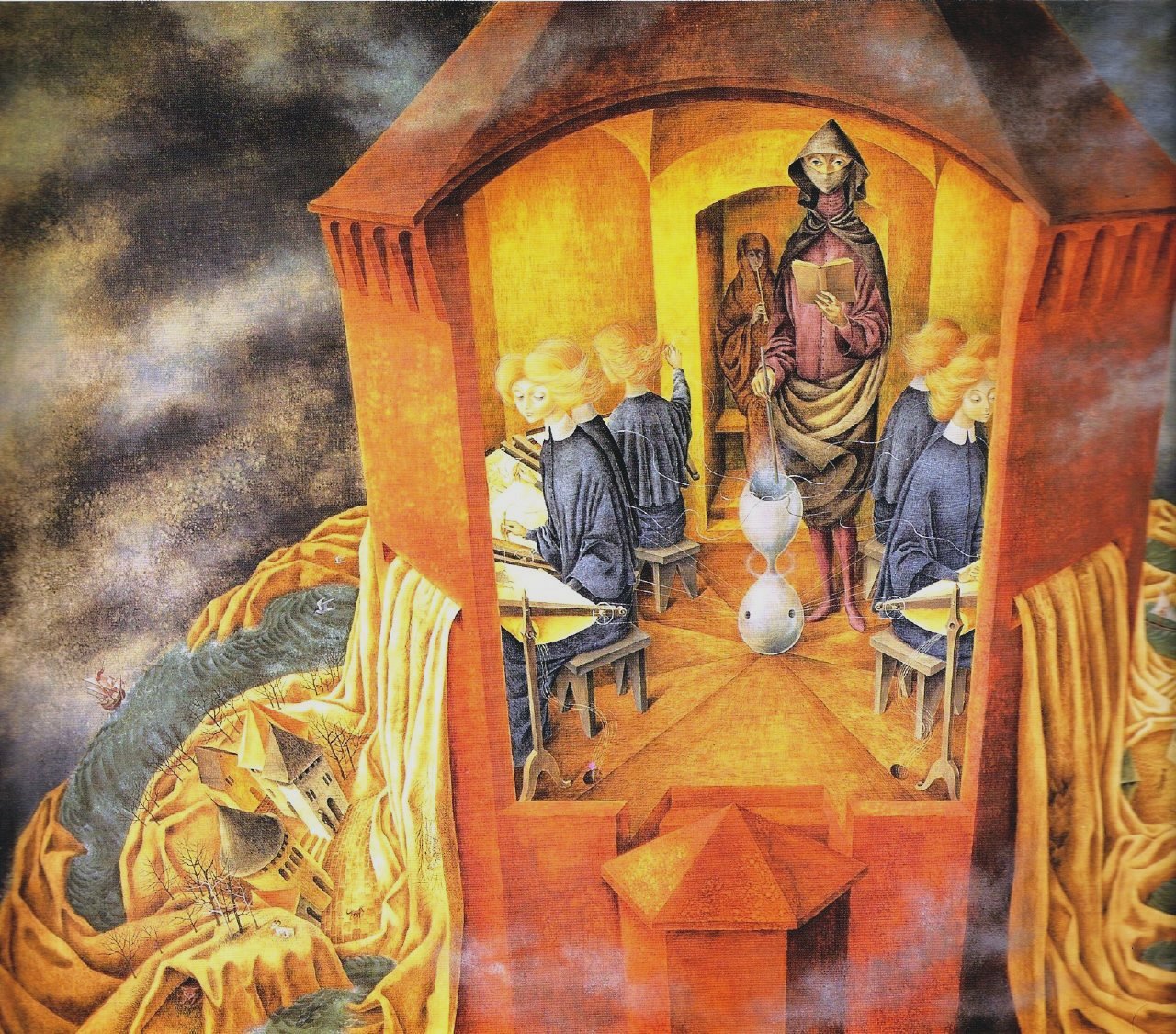
The Crying of Lot 49 – Thomas Pynchon, 1965

I read this around age 20 or so, at the recommendation of a friend who also turned me on to Pale Fire, but all I remembered was the underground postal system and the muted post horn symbol. It was recommended for the Great Books Group (although the person who nominated it couldn’t make it) and got one of my votes—although it seemed a little minor/fringe for us, at least it’s short, and we’re reading Moby-Dick next! I enjoyed it a lot and found its depiction of paranoia and conspiracy thinking quite relevant to today’s world, although it has such an innocent perspective. If we had read it in the 90s or 2000s, I don’t think it would have felt pertinent in the same way. The California real estate developer who turns out to own or have a finger in everything also rings of-the-moment. But most of all I loved the crazy character names and the humor, starting with this multi-level gem on page 2: “the Fort Wayne Settecento Ensemble’s variorum recording of the Vivaldi Kazoo Concerto, Boyd Beaver, soloist.” Great images as well, like palm lines described as “her fates’s furrows, the changeless salt hatchings of her identity.” But then also this crazy-awkward sentence, on purpose for sure:

Would then proceed at a KCUF record hop to look out again across the gleaming gym floor and there in one of the giant keyholes inscribed for basketball see, groping her vertical backstroke a little awkward opposite any boy heels might make her an inch taller than, a Sharon, Linda or Michele, seventeen and what is known as a hip one, whose velveted eyes ultimately, statistically would meet Mucho’s and respond, and the thing would develop then groovy as it could when you found you couldn’t get statutory rape really out of the back of your law-abiding head.

There are observations that were ahead of their time: “‘You’re so right-wing you’re left-wing,'” “the true paranoid for whom all is organized in spheres joyful or threatening about the central pulse of himself,” “the exitlessness, to the absence of surprise to life, that harrows the head of everybody American you know,” and one really eerily, upsettingly prescient: the swastika armband seller, a “spirited entrepreneur” expanding into SS uniforms for back-to-school.

I loved the meta-fictional stuff. My favorite by far is the Baby Igor submarine movie with the captain and the dog, which ends tragically even though such a film never would. Then there’s the long description of the Jacobean play The Courier’s Tragedy, including: “Certain things, it is made clear, will not be spoken aloud; certain events will not be shown onstage; though it is difficult to imagine, given the excesses of the preceding acts, what these things could possibly be.” “Every mode of violent death available to Renaissance man, including a lye pit, land mines, a trained falcon with envenom’d talons, is employed. It plays, as Metzger remarked later, like a Road Runner cartoon in blank verse.” And Metzger, the lawyer who was the child actor Baby Igor, explains:

A lawyer in a courtroom, in front of any jury, becomes an actor, right? Raymond Burr is an actor, impersonating a lawyer, who in front of a jury becomes an actor. Me, I’m a former actor who became a lawyer. They’ve done the pilot film of a TV series, in fact, based loosely on my career, starring my friend Manny Di Presso, a one-time lawyer who quit his firm to become an actor. Who in this pilot plays me, an actor become a lawyer reverting periodically to being an actor.

Another beautiful passage:

She looked down a slope … onto a vast sprawl of houses which had grown up all together, like a well-tended crop, from the dull brown earth; and she thought of the time she’d opened a transistor radio to replace a battery and seen her first printed circuit. The ordered swirl of houses and streets, from this high angle, sprang at her now with the same unexpected, astonishing clarity as the circuit card had. Though she knew even less about radios than about Southern Californians, there were to both outward patterns a hieroglyphic sense of concealed meaning, of an intent to communicate.

The one aspect I really disliked were the parody rock lyrics (the Paranoids have a lot of Beatles-esque songs), of which there were way too many anyway, even if they had been funny or accurately satirized – instead they were stupid and self-indulgent.

And thank you to this book for pointing me to Remedios Varo’s Bordando el Manto Terrestre. Wow!