- City of Gold and Other Stories from the Old Testament – Peter Dickinson, 1980 – Interesting re-tellings in various forms.
- Two Little Pilgrim’s Progress: A Story of the City Beautiful – Frances Hodgson Burnett, 1895 – A new-to-me Burnett (she’s one of the authors I’m completist about), set at the World’s Columbian Exhibition in Chicago (the “White City” of Devil in the White City and of a huge contemporaneous tattered photo book I used to own but can’t identify right now). Not great but it did re-awaken my time travel desire to experience it myself.
- The Pilgrim’s Regress – C.S. Lewis, 1933 – If I had read this before I don’t remember it. I found it very annoying initially, featuring the most insufferable aspects of Lewis (sexuality as “brown girls”), but it had some interesting aspects later on.
- 1493: Uncovering the New World Columbus Created – Charles Mann, 2011
- The Joy Luck Club – Amy Tan, 1989 – re-read for Great Books but I couldn’t be there (midterm)! I liked it fine but didn’t mark any passages.
- Captains Courageous – Rudyard Kipling, 1897 – Multiple multiple re-read, one of my all-time favorites. I think Moby-Dick triggered my desire to go back to it, even though “CC in space” would be a great plot; why doesn’t it exist?
1493: Uncovering the New World Columbus Created – Charles C. Mann, 2011
After reading 1491 in 2017, the Nature and Environment book group decided 1493 was a definite for 2018, and we pretty much all loved it, some even more than 1491.
The opening and closing frame is Mann in his garden, thinking about how it feels like home and yet it’s full of species from all over the globe: “Rather than being a locus of stability and tradition, my garden is a biological record of past human wanderings and exchange.” He argues that globalization began with Columbus. “Newspapers usually describe globalization in purely economic terms, but it is also a biological phenomenon; indeed, from a long-term perspective it may be primarily a biological phenomenon.”
One of the joys of reading Mann is historical tidbits that sometimes seem obvious in retrospect but which I’d never realized or thought about: “Fun, exciting, and wildly addictive, tobacco was an instant hit around the globe—the first time people in every continent simultaneously became enraptured by a novelty. N. tabacum was the leading edge of the Columbian Exchange.”
Although the potato raised farm production overall, its greater benefit was to make that production more reliable. Before S. tuberosum, summer was usually a hungry time, with stored grain supplies running low before the fall harvest. Potatoes, which mature in as little as three months, could be planted in April and dug up during the thin months of July and August. And because they were gathered early, they were unlikely to be affected by an unseasonable fall—the kind of weather that ruined wheat harvests. In war-torn areas, potatoes could be left in the ground for months, making them harder to steal by foraging soldiers. (Armies in those days did not march with rations but took their food, usually by force, from local farmers.)
There are plenty of tidbits that are just fun or interesting or both. Such a long list I’ll just bullet it:
- the Hakka ethnic group in China and their toulou fortresses
- the Chinese practiced smallpox inoculation as early as the 10th century
- the pre-Malthus Hong Liangji who predicted overpopulation and said “Heaven-and-earth’s way of making adjustments lies in flood, drought, and plagues”
- the description of the Andean potato as “less a single identifiable species than a bubbling stew of many related genetic identities,” complete with an amazing photo of potato variety. “The effects of [the introduction of potatoes] were so striking that any general history of Europe without an entry in its index for S. tuberosum should be ignored.”
- “…at least thirty-seven of the seventy worst insect pests in the United States were recent imports… The late nineteenth century was, in consequence, a time of insect plagues.”
- the importance of rubber. Mann quotes Susanna Hecht, a geographer at UCLA: “Three fundamental materials were required for the Industrial Revolution. Steel, fossil fuels, and rubber.”
- casta paintings (which I’ve now seen at the MFA and the Met)
- Talavera pottery: “More than likely, Puebla’s fake Chinese pottery was created in part by real Chinese potters. If so, they did a splendid job: talavera ware, as it is known today, is now so highly prized that when I visited Puebla shopkeepers complained that the country was fighting an invasion of counterfeits from China—a Chinese imitation of a Chinese-made Mexican imitation of a Chinese original.”
- the huge influence of the sweet potato, with populations “using sweet potato’s high yields and tolerance of bad soil to move into highland areas that had been lightly settled before. New Guinea was so transformed that some archaeologists speak of an ‘Ipomoean revolution.'”
- the history of the Ifugao terraces, which have been assumed to be millenia in the making, but turn out to be just a few hundred years old, and the growing popularity of landrace rice “As growing numbers of Ifugao farmers flock to join the project, a rising percentage of the area’s harvest—a precious cultural artifact—is being sent out of the country to affluent foreign food snobs. Worse, the cooperatives, standardization, and mechanized processing are dramatically changing Ifugao culture—all for the benefit (as one scientist put it) of faraway people who want to pat themselves on the back for their enlightenment as they click the link to order fancy multicolored rice.”
- the history of Muslims in China’s Fujian province: “Fujianese imams, most of whom did not speak Arabic, memorized the original text, declaiming it phonetically in the mosques. As memories faded, the services descended into gibberish, meaningless recitations before uncomprehending audiences. In one way, though, this remote outpost of Islam preserved tradition most faithfully: Zaytun’s Muslim families, old and new alike, were split into quarrelsome factions, Sunni, Shi’ite, and Sufi.”
I didn’t know that some Spaniards found the actions of the conquistadors disturbing and outrageous. And how successfully the slaves often revolted:
Exactly as Adam Smith would have predicted, they were dreadful employees. Faking sickness, working with deliberate lassitude, losing supplies, sabotaging equipment, pilfering valuables, maiming the animals that hauled the cane, purposefully ruining the finished sugar—all were part of the furniture of plantation slavery. “Weapons of the weak,” political scientist James Scott called them in a classic study of the same name. The slaves were not so weak when they escaped to the heights. Hidden by the forest from European eyes, they made it their business to wreck the industry that had enchained them. For more than a century, African irregulars ranged unhindered over most of Hispaniola, funding their activities by covertly exchanging gold panned from mountain rivers with Spanish merchants for clothing, liquor, and iron (ex-slave blacksmiths made arrow points and swords).
and formed maroon communities:
Thousands of fugitive communities dotted Brazil, much of the rest of South America, most of the Caribbean and Central America, and even parts of North America—more than fifty existed in the United States. Some covered huge areas and fought colonial governments for decades. Others hid in wet forests in the lower Amazon, central Mexico, and the U.S. Southeast. All were scrambling to create free domains for themselves—“inventing liberty,” in the phrase of the Brazilian historian João José Reis. They have been called by a host of names: quilombos, yes, but also mocambos, palenques, and cumbes. In English they are usually called “maroon” communities—the term apparently comes, poignantly, from símaran, the Taino word for the flight of an arrow.
American history is often described in terms of Europeans entering a nearly empty wilderness. For centuries, though, most of the newcomers were African and the land was not empty, but filled with millions of indigenous people. Much of the great encounter between the two separate halves of the world thus was less a meeting of Europe and America than a meeting of Africans and Indians—a relationship forged both in the cage of slavery and in the uprisings against it. Largely conducted out of sight of Europeans, the complex interplay between red and black is a hidden history that researchers are only now beginning to unravel.
And others which were complete surprises, like that malaria was widespread in England in the 17th century. It wasn’t very long ago that I even knew that malaria continually undergoes change. In turn that explains, per Mann, one of the reasons for the African slave trade: the imported slaves were more likely to be resistant to the malaria that found a home in the Americas, which debilitated the indigenous peoples: “adult West and Central Africans were and are less susceptible to malaria than anyone else on earth.”
Biology enters history when one realizes that almost all of the slaves ferried to the Americas came from West and Central Africa. In vivax-ridden Virginia and Carolina, they were more likely to survive and produce children than English colonists. Biologically speaking, they were fitter, which is another way of saying that in these places they were—loaded words!—genetically superior.
Racial theorists of the last century claimed that genetic superiority led to social superiority. What happened to Africans illustrates, if nothing else, the pitfalls of this glib argument. Rather than gaining an edge from their biological assets, West Africans saw them converted through greed and callousness into social deficits. Their immunity became a wellspring for their enslavement.
Malaria did not cause slavery. Rather, it strengthened the economic case for it, counterbalancing the impediments identified by Adam Smith.
Then there’s a huge lesson to be learned about money. I had no idea that China’s currency was unstable for so long. Mann vividly depicts the uncertainty and risk when an new emperor could unilaterally decree that the previous regime’s money was worthless, an explains the attraction of silver. A footnote explains “To those accustomed to metal coins, the idea of using shells for money may seem primitive. But they had a signal advantage: unlike the era’s coins, which were often debased or faked, shells could not readily be altered or counterfeited.”
Needing something to pay with, merchants and their customers would use old coins from earlier reigns until the new emperor’s money arrived; given the lack of copper and dynastic inefficiency, this frequently took years, even decades. Then they would use the new coins until the government suddenly banned them. The result, according to the Taiwanese historian Quan Hansheng, was a constant game of financial hot-potato, with everyone trying to use their coins until just before they lost all value—at which point they would try to unload them onto some hapless sucker.
Then silver comes along and “as if in a libertarian fantasy, the money supply was effectively privatized.”
Mann tells the story of “the man known variously as Esteban, Estevan, Estevanico, or Estebanico de Dorantes, an Arabic-speaking Muslim/Christian raised in Azemmour, Morocco,” and ends with a powerfully-creepy version of his death I can’t find elsewhere:
The Zuni themselves have a different story—stories, I should say, because many have been recounted. In one version told to me, Esteban is not refused entry, but welcomed into Hawikuh. The people have heard of this man and his extraordinary journey. They want to keep him there—want this very badly, at least in the story. He is a man like no other they have encountered, an incredible physical specimen with his skin and hair, a man whose spirit holds a great wealth of knowledge and perhaps more, a valuable possession they have no desire to lose.
To prevent his departure, they cut off his lower legs, lay him gently on his back, and bathe themselves in his supernatural presence. Esteban lives in this way for many years, the story goes, always treated with the respect due to such uncommon figures, always on his back, legs stretched out, with the wrappings on his stumps carefully tended.All versions of his end are based on stories that people have told to themselves. His actual fate may never be known with certainty. What seems clear is that in the end this man who crossed so many bridges fell into the same delusion that possessed so many Spaniards. He thought that he understood the shook-up world he was creating and that he was in control. He forgot that under bridges is only air.
The book closes in a way that echoes Mann in his garden at the opening: he reflects on a Tagalog song, “Bahay Cumbo,” about an idealized Filipino garden, and reflects on the human relationship to the environment.
Like my own tomato patch, the garden extolled in “Bahay Kubo” is an exotic modern object. Far from being an exemplar of age-old custom, it is a polyglot, cosmopolitan, thoroughly contemporary artifact.
Smart phones, aerodynamic sneakers, beige faux-leather living-room sets—people desire these things. Absent catastrophe, they will get them. Or their children will.
On the other hand, the same people who want to satisfy their desires also resist the consequences of satisfaction. They want to have what everyone else has, but still be aggressively themselves—a contradictory enterprise. Floating in the capitalist stream, they reach down with their feet, looking for solid ground. To be a good place to stand, it must be their own, not somebody else’s place. As human desires bring the Homogenocene into existence, billions of people marching through increasingly identical landscapes, that special place becomes ever harder to find.
Gardeners work in partnership, more or less successfully, with what nature provides. They experiment all the time, fiddling with this, trying out that. People take seeds and stick them in the ground to see what happens—that’s how Ifugao villagers bred hundreds of types of rice in a few centuries. An essential factor is that gardeners experience the consequences of their own actions. They make decisions and expend labor; a few months later they discover what they have wrought. Externalities are rare. Gardens are places of constant change, but the changes are owned by the gardener—which is why they feel like home.
Finally, I loved this pithy statement from Appendix A, “Fighting Words,” about his approach to terminology: “the two definitions of race, genetic and social, are only loosely connected—one reason that discussions of race are so often dialogues of the deaf.”
January 2018 books read
- Mister God, This is Anna – “Fynn”, 1975. I first read this in my grandmother’s collection, probably not long after it came out. She presumably got it or liked it because it’s “Christian,” but it isn’t very… more a weird mix of metaphysics, math, and Cockney life. Before the Internet I looked but couldn’t find much information; now there’s a site devoted to MGTIA and its author, Sydney George Hopkins.
-

Master Frisky, Clarence Hawkes’ dog Hitting the Dark Trail (1915); Master Frisky (1902) – Clarence Hawkes. I started a Hawkes kick in December because he’s a local author, and they’re interesting for that reason, but otherwise not very good. There’s more on his blindness in Dark Trail, but not much, and a lot of things that are confusing (he does a lot of research by studying maps? how? No mention of them being relief maps, and where would he get those? It may be that by “I” he means “me and my wife?”) And Frisky, about his adorable collie, wanders all over the place, with plenty of misbehaving-but-cute-youngster-ends-up-dead anecdotes which characterize early moralizing tales.
- The Selfish Gene – Richard Dawkins, 2016 (4th edition; first was 1976)
- The Underground Railroad – Colson Whitehead, 2016
- Four Day’s Wonder – A. A. Milne, 1933. Cute and silly mystery.
- Literary Wonderlands: A Journey Through the Greatest Fictional Worlds Ever Created – ed. Laura Miller, 2016
- Moby-Dick; or, The Whale – Herman Melville, 1851 – quotes pulled, review tdb
- D’Aulaire’s Book of Norse Myths – Ingri and Edgar Parin D’Aulaire, 1967. I first read most of this in a bookstore as a kid—I think Shakespeare and Co. in Paris!–enchanted by the colorful lithograph-looking illustrations (the jacked says they used acetate sheets) but unable to justify the price. Still beautiful and interesting, and the new introduction by Michael Chabon is great.
- How to Read Nancy: The Elements of Comics in Three Easy Panels – Paul Karasik & Mark Newgarden, 2017
- The Lathe of Heaven – Ursula K. Le Guin. Re-read in honor of her death. A perfect novel in every way.
- Roadside Picnic – Arkady and Boris Strugatsky, 1971. Read to discuss Stalker at the Forbes Far Out Film Discussion. It’s not as unlike the movie as Tarkovsky claims, but enough unlike that I wish I hadn’t read it before watching, as it threw off a lot of my reactions. Interesting conceit but I didn’t care much for it–a little too “just so.”

The Selfish Gene (40th anniversary edition) – Richard Dawkins, 2016 (original 1976, 2nd ed. 1989)
Interestingly most of the Nature and Environment book group members didn’t care for this; none of them had read it before and most felt they didn’t have the background to make sense of it. I didn’t think I had much of a background myself, but it is a topic that’s interested me for a long time (Jacques Monod’s Chance and Necessity, one of the formative volumes of my adolescence, is kind of related, and I absolutely loved the Coursera Intro to Genetics and Evolution with Dr. Mohamed Noor – one of the best MOOCs I’ve taken.) It is true that while Dawkins is very clear in the particulars, the structure is a little lacking.
My strategy of reading all text first and then the endnotes also paid off, as the notes are very long and, as others complained, often contradict the text because they were written later.
Evolution is a theory which seems simple but which has subtle implications. I tried to explain to the group my understanding of what Dawkins was trying to say about many small gametes vs fewer larger gametes leading to the polarization of male and female sexual strategies, and how that works out differently in water than on land, but I didn’t do a very good job.
Interesting bits:
- Queen and worker bees have differing interests—explaining why workers can and do overthrow the queen sometimes
- Good explanation of game theory strategies, with “nice” winning over “nasty,” forgiving but not too much so—“Tit for Tat” winner described as “nice,” “forgiving,” “not envious.”
- “Segregation distorters” (meiotic drive) that spread like wildfire throughout a population because they game the system, then force extinction.
- Fantastic quote from Robert May: “To a good approximation, all species are insects.”
- Thisbe irenea caterpillars summon ants through sound and control them chemically!
- Dawkins theorizes that naked mole rats ought to have dispersing individuals as the eusocial insects do, and it looks like he was right, but not in the interesting locust-like way he speculates: “What if naked mole rats are like American grasshoppers, primed to produce a distinct, dispersing caste, but only under conditions which, for some reason, have not been realized this century?” Actually it seems to have been proven that the Rocky Mountain locust went extinct, so even that is not applicable.
- Because this book was fresh in my mind, I was especially fascinated by the news on the marbled crayfish that clones itself.
A funny anecdote: “[The cyclic interbreeding theory] is commonly attributed to S. Bartz, who developed it seven years after Hamilton originally published it. Characteristically, Hamilton himself forgot that he had thought of the ‘Bartz theory’ first, and I had to thrust his own paper under his nose before he would believe it!”
I usually try to structure the quotes in some way, but this is another finishing-it-months-later post and these mostly stand alone so I’ll just dump them here. One more comment: we all complained about Dawkins’ huge ego and frequent sexism. Nonetheless, it’s a classic for a reason and I want to re-read it at some point. I’d love to absorb the arguments enough to successfully explain them to someone else. The ideas about evolutionary stable strategies and the math and game theory that explains them, and group vs individual vs genome vs gene unity, feel powerfully explanatory.
Quoting Robert Trivers in the intro: “…if … deceit is fundamental in animal communication, then then there must be strong selection to spot deception and this ought, in turn, to select for a degree of self-deception, rendering some facts and motives unconscious so as not to betray—by the subtle signs of self-knowledge—the deception being practiced.”
Let us try to teach generosity and altruism, because we are born selfish. Let us understand what our own selfish genes are up to, because we may then at least have a chance to upset their designs, something that no other species has ever aspired to.
…uncles on the mother’s side should be more interested in the welfare of nephews and nieces than uncles on the father’s side, and in general should be just as altruistic as aunts are. Indeed in a society with a high degree of marital infidelity, maternal uncles should be more altruistic then ‘fathers’ since they have more confidence in their relatedness to the child.
Depending on the ecological details of the species, various mixes of caring and bearing strategies can be evolutionarily stable. The one thing that cannot be evolutionarily stable is a pure caring strategy.
When a woman reached the age when the average chance of each child reaching adulthood was just less than half the chance of each grandchild of the same age reaching adulthood, any gene for investing in grandchildren in preference to children would tend to prosper… A woman could not invest fully in her grandchildren if she went on having children of her own. Therefore genes for becoming reproductively infertile in middle age become more numerous, since they were carried in the bodies of grandchildren whose survival was assisted by grandmotherly altruism.
Genes in juvenile bodies will be selected for their ability to outsmart parental bodies; genes in parental bodies will be selected for their ability to outsmart the young. There is no paradox in the fact that the very same genes successively occupy a juvenile body and a parental body… they will exploit their practical opportunities.
Like a fashion in women’s clothes, or in American car design, the trend toward longer [bird of paradise] tails took off and gathered its own momentum. It was stopped only when tails became so grotesquely long that their manifest disadvantages started to outweigh the advantage of sexual attractiveness.
It is even possible that man’s swollen brain, and his predisposition to reason mathematically, evolved as a mechanism of ever more devious cheating, and ever more penetrating detection of cheating in others. Money is a formal token of delayed reciprocal altruism.
What, after all, is so special about genes? The answer is that they are replicators. … If forms of life exist whose chemistry is based on silicon rather than carbon, or ammonia rather than water, … if a form of life is found that is not based on chemistry at all but on electronic reverberating circuits, will there still be any general principle that is true of all life? Obviously I do not know, but, if I had to bet, I would put my money on one fundamental principle. This is the law that all life evolves by the differential survival of replicating entities. The gene, the DNA molecule, happens to be the replicating entity that prevails on our own planet.
All that genes can really influence directly is protein synthesis. A gene’s influence upon a nervous system, or, for that matter, upon the color of an eye or the wrinkliness of a pea, is always indirect. … The caddis house is only a further extension of this kind of sequence. Stone hardness is an extended phenotypic effect of the caddis’s genes. … [T]he next step in this argument: genes in one organism can have extended phenotypic effects on the body of another organism.
To quite a large extent the interests of parasite genes and host genes may coincide. From the selfish gene point of view we can think of both fluke genes and snail genes as ‘parasites’ in the snail body. Both gain from being surrounded by the same protective shell, though they diverge from one another in the precise thickness of shell that they ‘prefer.’ This divergence arises, fundamentally, from the fact that their method of leaving this snail’s body and entering another one is different. For the snail genes the method of leaving is via snail sperms or eggs. For the fluke’s genes it is very different.
A bird may be flying home, carrying food for its own young. Suddenly, out of the corner of its eye, it sees the red super-gape of a young cuckoo, in the nest of a bird of some quite different species. It is diverted to the alien nest where it drops into the cuckoo’s mouth the food that had been destined for its own young. … if we do assume that the cuckoo’s gape is a powerful drug-like superstimulus, it becomes very much easier to explain what is going on. It is not being stupid. ‘Fooled’ is the wrong word to use. Its nervous system is being controlled, as irresistibly as if it were a helpless drug addict…
Living things, of course, were never designed on drawing boards. But they do go back to fresh beginnings. They make a clean start in every generation. Every new organism begins as a single cell and grows anew. It inherits the ideas of ancestral design, in the form of the DNA program, but it does not inherit the physical organs of its ancestors. It does not inherit its parent’s heart and remould it into a new (and possibly improved) heart. It starts from scratch, as a single cell, and grows a new heart, using the same design program as its parent’s heart, to which improvements may be added. … One important thing about a ‘bottlenecked’ lifestyle is that it makes possible the equivalent of going back to the drawing board.
All printed copies of this book will be the same as one another. They will be replicas but not replicators. … They do not form a lineage of copies, with some books being ancestral to others. A lineage of copies would exist if we xeroxed a page of a book, then xeroxed the xerox, then xeroxed the xerox of the xerox, and so on. In this lineage of pages, there really would be an ancestor/descendant relationship. A new blemish that showed up anywhere along the series would be shared by descendants but not ancestors. An ancestor/descendant series of this kind has the potential to evolve.
Superficially, successive generations of stick-insect bodies appear to constitute a lineage of replicas. But if you experimentally change one member of a lineage (for instance by removing a leg), the change is not passed on down the lineage. By contrast, if you experimentally change one member of the lineage of genomes (for instance by X-rays), the change will be passed on down the lineage. This, rather than the fragmenting effect of meiosis, is the fundamental reason for saying that the individual organism is not the ‘unit of selection’—not a true replicator. It is one of the most important consequences of the universally admitted fact that the ‘Lamarckian’ theory of inheritance is false.
How to Read Nancy: The Elements of Comics in Three Easy Panels – Paul Karasik & Mark Newgarden, 2017
Wow, do I love books like this in general—there didn’t use to be enough of them, but now they’re everywhere!—and this is a great one. It took me years to start appreciating Nancy properly, even though my parents had the hardcover The Avant-Garde (Art News Annual XXIV, 1968) with the Joe Brainard cover on their shelves. My mother disapproved of comics in general, but my grandmother saved the Wilmington, NC Sunday funnies for us and whenever my brother and I visited, we’d have an orgy of them. My favorite was Hagar the Horrible; I also vividly remember Snuffy Smith. Peanuts, Prince Valiant (I never followed what the heck was going on but I liked the costumes), Blondie, Beetle Bailey, and Dennis the Menace. I don’t think Nancy was included; too Yankee? But I’m sure I saw it somewhere along the way, and became more familiar with it through Jonathan and his brother Sam (they wrote the song “Nancy” for their band, The Degrads, featuring lyrics like “Her hair makes me want to go bowling/She announces where she’s going when she’s strolling”). It was Bill Griffith’s tributes to Bushmiller, starting with the three rocks, that first opened my eyes to the genius behind Nancy’s weird and wonderful stylization. This book deepens that appreciation, but more generally it’s about how to see and analyze comics. One of my favorite books of all time is Scott McCloud’s Understanding Comics: The Invisible Art, which I first read soon after the paperback came out in 1994; I don’t know if I’d get as much out of this book if it were my first exposure to those ideas, but in conjunction they’re powerful.
The book’s preamble is a biography of Bushmiller and Nancy the strip, stuffed with illustrations. Bushmiller started as a crossword puzzle inker, which helps explain his skill with black/white composition and contrast! It’s an enjoyable essay, typical of these large-format collections—very well-done but nothing particularly surprising.
The meat of the book is 44 two-page chapters, all on the same 3-panel strip that first ran on 8/8/1959, in which Sluggo squirts two successive kids in the face with his water gun (“Draw, you varmint”) and is then drawing on Nancy while we see that she’s put the trigger of a water hose in her holster. The strip takes up the top third of both pages, reprinted each time with only the elements the chapter is focused on: just Sluggo, just Bushmiller’s signature, just the grass, etc. These are grouped into color-coded sections like “The Script,” “The Cast,” “Staging,” etc. The accompanying text is in 3 parts: Context, Text, and Moral (eg “Letters form words, and their forms compound their meaning.” “A white halo around an object grants prominence.”)
I have a small complaint: sometimes there’s this weird purple language about what’s going to happen next (“Sociopath Sluggo … projects his own scurrilous varminthood upon his innocent quarry. Such patently unjust behavior is more deserving of the harsh, wet reward that awaits him at the end of the trail.”) And one minor thing they missed that I wish had been pointed out in the chapter on Punctuation: the three commas are all more different from each other than Bushmiller’s typical careful lettering would lead you to think. But in general the essays are terrific and enabled me to see and appreciate far more in the strip than I could have on my own, in ways that are applicable not only to comics but to art in general.
The appendices were even more fascinating. There are several on the varying ways the original strip was printed and how (badly), historical information on the BenDay dots and tableaux vivants. My favorite was the incredibly exhaustive history of hose gags, starting with a look at Lumière’s 1895 “L’Arroseur Arrosé,” but quickly proving that it was far from the first (1885, Uzès in Le Chat Noir) or the last (seventeen more are reproduced and analyzed!) I also loved the look at repeated Nancy gags, like the bird flying down the one-way street; the analysis of Sunday strips and how un-Bushmiller it was to supply an unnecessary top third (since some papers ran it and some didn’t); the section on spotting blacks, with an inked original next to the grayish reproduction on newsprint (I also learned about the “mats,” cardboard-like molds made from an acid-etched printing plate that could be cheaply manufactured and mailed to newspapers). Some unfinished strips are reproduced, showing Bushmiller’s stated working method of doing pencil, inking, and lettering in various orders, which also proves that he did Nancy’s hair spikes last—her head is completely smooth in some of them! Another great one is called “How To/How Not To” and compares a Little Debbie (Cecil Jensen) to a Nancy strip from 1955, both on the same gag, ripping apart the former.
The book ends with Do It Yourself!, a page of four Nancy strips for each of the forty-two “lessons” (omitting a couple that don’t apply, like Bushmiller’s signature) so you can look at them through that lens.
And it’s a gorgeously big and well-designed book, too. A winner!
Literary Wonderlands: A Journey Through the Greatest Fictional Worlds Ever Created – ed. Laura Miller, 2016
I love books-about-books, classic fantasy illustrations, and Laura Miller, so this was perfect for me. It’s a two to four page spread on each of several dozen books, in the categories Ancient Myth & Legend, Science and Romanticism, Golden Age of Fantasy, New World Order, and The Computer Age. There’s a brief essay on the book, first publication information (which is cool and not often mentioned), the original cover or a photo of the earliest tablet/papyrus etc., a portrait of the author if applicable, and lots of supporting graphics—illustrations, art, maps, ephemera, etc. It’s a beautiful book. I’ve read most of the works mentioned, but there were several I’d never heard of and want to check out:
- The City of the Sun – Tommaso Campanella, 1602
- The Description of a New World, Called the Blazing-World – Margaret Cavendish, 1666
- The Journey of Niels Klim to the World Underground – Ludvig Holberg, 1741
- Alamut – Vladimir Bartol, 1938
- Pedro Paramo – Juan Rulfo, 1955
- W or the Memory of Childhood – Georges Perec, 1975
- Egalia’s Daughters – Gerd Brantenberg, 1977
- Obabakoak – Bernardo Atxaga, 1988
- Wizard of the Crow – Ngũgĩ wa Thiong’o, 2006
- The Man with the Compound Eyes – Wu Ming-Yi, 2011
- The Imperial Radch Trilogy – Ann Leckie, 2013-15
- Lagoon – Nnedi Okarafor, 2014
Plus reminding me of a bunch of authors/books I haven’t yet read and want to, like China Mievelle, Orlando Furioso, Cloud Atlas, etc.
The Underground Railroad – Colson Whitehead, 2016
Read for the Second Monday book group. I was intrigued by the premise (an alternate world where the Underground Railroad was an actual network of tunnels with real trains), but that turned out to be a minor and annoying feature of an mostly-realistic and harrowing novel. Whitehead says that as a child, he thought the UR was real rather than metaphorical; I can confirm from my library career in Montrose, PA, which was a stop (and a terminus) on the UR, that many adults still think so. I can’t put my finger on exactly how it could have been done, but IMO Whitehead should have handled the “real” UR stuff so that it was more clearly metaphorical or magical realist. As it is, it’s mostly preposterous without being useful to the novel, which is otherwise good. The other alternate-history passages, namely the way different states have adopted different strategies, explicitly inspired by Gulliver’s Travels, work. There’s actually a passage at the end which redeemed the real trains for me, but it was just too little too late. But in looking back at my flags, maybe I’m wrong and I would need to read it again. Here’s the passage I wish I had thought more about on initial reading:
The tunnel pulled at her. How many hands had it required to make this place? And the tunnels beyond, wherever and how far they led? She thought of the picking, how it raced down the furrows at harvest, the African bodies working as one, as fast as their strength permitted. The vast fields burst with hundreds of thousands of white bolls, strung like stars in the sky on the clearest of clear nights. When the slaves finished, they had stripped the fields of their color. It was a magnificent operation, from seed to bale, but not one of them could be prideful of their labor. It had been stolen from them. Bled from them. The tunnel, the tracks, the desperate souls who found salvation in the coordination of its stations and timetables—this was a marvel to be proud of.
Later:
The iron horse still rumbled through the tunnel when she woke. Lumbly’s words returned to her: If you want to see what this nation is all about, you have to ride the rails. Look outside as you speed through, and you’ll find the true face of America. It was a joke, then, from the start. There was only darkness outside the windows on her journeys, and only ever would be darkness.
And in the final pages:
She pumped and pumped and rolled out of the light. Into the tunnel that no one had made, that led nowhere. … Was she traveling through the tunnel or digging it? Each time she brought her arms down on the lever, she drove a pickaxe into the rock, swung a sledge onto a railroad spike. She never got Royal to tell her about the men and women who made the underground railroad. The ones who excavated a million tons of rock and dirt, toiled in the belly of the earth for the deliverance of slaves like her. Who stood with all those other souls who took runaways into their homes, fed them, carried them north on their backs, died for them. The station masters and conductors and sympathizers. Who are you after you finish something this magnificent—in constructing it you have also journeyed through it, to the other side. On one end there was who you were before you went underground, and on the other end a new person steps out into the light. The up-top world must be so ordinary compared to the miracle beneath, the miracle you made with your flesh and blood. The secret triumph you keep in your heart.
So maybe I should re-read this at some point, because it may be that the why of the UR being real was just too subtle for me on a first reading. I do tend to read quickly for book groups; that’s one of the reasons I love when it’s something I’ve already read.
The book is full of memorable lines. “Stubborn breaks when it don’t bend.” About children killed on the Randall plantation: “At least they were never sold off, an older woman told Ajarry. Which was true—back then Randall rarely sold the little ones. You knew where and how your children would die.” Fighting among the slaves: “Take it out on each other if you cannot take it out on the ones who deserve it.” A quote from the slavecatcher Ridgeway: “‘Here was the true Great Spirit, the divine thread connecting all human endeavor—if you can keep it, it is yours. Your property, slave or continent. The American imperative.'” “The almanac had a strange, soapy smell and made a cracking noise like fire as she turned the pages. She’d never been the first person to open a book.”
Cora on the “historical” displays in the museum where she’s forced to work as a living exhibit:
The stuffed coyotes on their stands did not lie, Cora supposed. And the anthills and the rocks told the truth of themselves. But the white exhibits contained as many inaccuracies and contradictions as Cora’s three habitats. … But nobody wanted to speak on the true disposition of the world. And no one wanted to hear it. Certainly not the white monsters on the other side of the exhibit at that very moment, pushing their greasy snouts against the window, sneering and hooting.Truth was a changing display in a shop window, manipulated by hands when you weren’t looking, alluring and ever out of reach.
And her tactic of picking out people in the crowd to stare at:
The weak link—she liked the ring of it. To seek the imperfection in the chain that keeps you in bondage. Taken individually, the link was not much. But in concert with its fellows, a mighty iron that subjugated millions despite its weakness. The people she chose, young and old, from the rich part of town or the more modest streets, did not individually persecute Cora. As a community, they were shackles.
About a white boy who ends up dead as a consequence of her fleeing:
The boy’s death was a complication of her escape … But shutters swung out inside her and she saw the boy trembling on his sickbed, his mother weeping over his grave. Cora had been grieving for him, too, without knowing it. Another person caught in this enterprise that bound master and slave alike.
Cora on poetry:
Versifying left her cold. Poems were too close to prayer, rousing regrettable passions. Waiting for God to rescue you when it was up to you. Poetry and prayer put ideas in people’s heads that got them killed, distracting them from the ruthless mechanism of the world.
A speech by Elijah Lander, whom various reviews claim stands in for Frederick Douglass or W.E.B. Dubois:
We can’t save everyone. But that doesn’t mean we can’t try. Sometimes a useful delusion is better than a useless truth. Nothing’s going to grow in this mean cold, but we can still have flowers. Here’s one delusion: that we can escape slavery. We can’t. Its scars will never fade. When you saw your mother sold off, your father beaten, your sister abused by some boss or master, did you ever think you would sit here today, without chains, without the yoke, among a new family? Everything you ever knew told you that freedom was a trick—yet here you are. Still we run, tracking by the good full moon to sanctuary.
Valentine farm is a delusion. Who told you the negro deserved a place of refuge? Who told you that you had that right? Every minute of your life’s suffering has argued otherwise. By every fact of history, it can’t exist. This place must be a delusion, too. Yet here we are.
And America, too, is a delusion, the grandest one of all. The white race believes—believes with all its heart—that it is their right to take the land. To kill Indians. Make war. Enslave their brothers. This nation shouldn’t exist, if there is any justice in the world, for its foundations are murder, theft, and cruelty. Yet here we are.
Runaway slave ads appear as chapter headings. The last is one of the best moments in the book:
RAN AWAY
from her legal but not rightful master …
She has stopped running.
Reward remains unclaimed.
SHE WAS NEVER PROPERTY.
It took me a long long time to finish this entry (read the book for a 1/8/2018 meeting, hitting “publish” on 4/7/2018 even though I back-date to when I read) and the book has stuck in my mind, raising its profile. I do want to read it again at some point and highly recommend it.
December 2017 books read
- Out of the Silent Planet (1938), Perelandra (1943), That Hideous Strength (1945) – C.S. Lewis. Re-re-read. I love these so much still… weaknesses and all.
- The Flight of Dragons – Peter Dickinson, 1979; illustrated by Wayne Anderson. I read this book many times at FNAC while we were living in Paris (I was 15 or so), very tempted to buy it but it was out of my price range. Scientifically-plausible (kinda) theory of how legends of dragons could be true.
- Lab Girl – Hope Jahren, 2016
- The Light That Did Not Fail – Clarence Hawkes, 1935. Hawkes, “the blind poet of Hadley,” lived just across the river. I first heard about him because of an inscription on a boulder on the upgraded Norwottuck Trail, and found out much more at the Hadley Historical Society. I have a genetic risk for blindness so I was particularly interested in this book, but it’s actually a hodge-podge of reminiscences with a lot of extraneous content like flattering letters from other famous people to Hawkes, and not much about how he dealt with his blindness. It sounds like Hitting the Dark Trail is more what I’m looking for.
- The Hogwarts Collection – J. K. Rowling, 2017. I was eager to read the extra content on Pottermore when it opened, but a whole bunch of it reminds me how good the books themselves were and how unnecessary the backstory is.
- The Crying of Lot 49 – Thomas Pynchon, 1965
- The Sparrow – Maria Doira Russell, 1996. I didn’t realize how old this was–just heard about it a few years ago–and so the near-future (late 2010s) confused me at first. Interesting, weird, not top-notch.
- A Christmas Carol – Charles Dickens, 1843. One of my all-time favorites, re-read for the umpteenth time.
- Banker (1982), Forfeit (1968) – Dick Francis. Two I remembered particularly fondly, but my taste for Francis (picking up one used to lead to re-reading all of them) is on the wane.
- Salt, Fat, Acid, Heat: Mastering the Elements of Good Cooking – Samrin Nosrat, 2017. Wow! Highly recommended!
- Weathercraft (2010), Fran (2013) – Jim Woodring. I love Frank in general, but the earlier stuff feels fresher to me… good Pupshaw and Pushpaw action in these, though.
- Donald Duck: A Christmas for Shacktown – Carl Barks, Fantagraphics collection 2012. Matthew and I grew up on the French Scrooge McDuck comics, Picsou, which were primarily translated Carl Barks (the “good duck artist”). A taste once in a while is good enough, but I’m periodically on the hunt for my favorite story from back then. As I recall, it featured a fruit like a pineapple which made the eater super-intelligent. Scrooge ends up needing to feed it to sled dogs so they can get the ducks out of a predicament. No search strings have pulled this up yet…
Lab Girl – Hope Jahren, 2016
Yikes, I am so behind on this blog that I’m finishing this December 2017 post in June 2018… trying to catch up but especially prompted on this one because Lab Girl is the UMass Common Read this summer and I may get to see Hope Jahren speak in September. Plus Five Colleges (my workplace) is encouraging us to read and discuss all four common reads for the participating campuses. I love the Pioneer Valley!
This was the December Nature and Environment book group selection, and an interesting contrast to H is for Hawk. Both of them were placed at the end of the year because they were still popular and the library asked us to wait for the demand to die down. They are also both what I loosely classify as “cross-disciplinary” titles for the purposes of the group (a type we alternate with classics of nature writing and oh-my-god-we’re-all-going-to-die current issues).
Overall I enjoyed it a lot, but became more and more impatient with Jahren’s over-the-topness/nuttiness, especially around an epically-disastrous van trip, until she revealed her bipolar diagnosis. Then everything made a lot more sense; I would have had more sympathy had she introduced it earlier. The book still reeks of superhero syndrome, which is how I think of memoirs (most often of teaching) by people in very difficult roles who succeed against all odds in a way that is completely not sustainable or replicable.
In the early memoir section I loved the David Copperfield thread. Her stories of working in a hospital lab prepping IV bags as a teen are fascinating:
If this is for the ER or the ICU, we have about ten minutes to make it happen. Fortunately for the patient, there is a sleep-starved teenager apprenticed to a chain-smoking barmaid in the basement who is ready for action.
(Lydia, the chain-smoking tech who takes Hope under her wing, reminds me very much of a senior kennel aide I worked with at Angell Memorial Animal Hospital in the 80’s.)
[I was forced] to manage the timing and extent to which I could wander through my own thoughts, and I developed a fine control over my ability to reemerge. I could work with my brain in my hands for hours, move it into my head for twenty minutes, and then shunt it back into my fingers in the same way that I could slosh water back and forth in a half-full bucket.
Interspersed between the memoir chapters are shorter bits about the germination, growth, life, and death of plants. These are great (especially in contrast with The Hidden Life of Trees, which we read later). Jahren’s metaphors are both brilliant and illuminating.
Folded within the embryo are the cotyledons: two tiny ready-made leaflets, inflatable for temporary use. They are as small and insufficient as the spare tire that is not intended to take you any farther than the nearest gas station. Once expanded with sap, these barely green cotyledons start up photosynthesis like an old car on a bitter winter morning. Crudely designed, they limp the whole plant along until it can undertake the construction of a true leaf, a real leaf.
The evolution of leaf into spine: “One new idea allowed the plant to see a new world and draw sweetness out of a whole new sky.” Trees are “always doing something.” “Soil is the naturally produced graffiti that results from tensions between the biological and geological realms.”
By suspending each leaf separately, the tree has stacked its surface area into a sort of ladder for light to fall down. Looking up, you notice that the leaves at the top of any tree are smaller, on average, than the leaves at the bottom. This allows sunlight to be caught near the base whenever the wind blows and parts the upper branches. Look again and you’ll notice that leaves low in the canopy are of a darker green; they contain more of the pigment that helps each leaf absorb sunshine, allowing them to harvest the weaker rays that penetrate shade. When building foliage, a tree must budget for each leaf individually and allocate for each position relative to the other leaves.
A cactus doesn’t live in the desert because it likes the desert; it lives there because the desert hasn’t killed it yet. Any plant that you find growing in the desert will grow a lot better if you take it out of the desert. The desert is like a lot of lousy neighborhoods: nobody living there can afford to move.
The later memoir sections are full of touching, hilarious, and horrifying moments. Discovering opal in the hackberry seed: “it still stands out as one of the loneliest moments of my life. On some deep level, the realization that I could do good science was accompanied by the knowledge that I had formally and terminally missed my chance to become like any of the women that I had ever known.”
Jahren’s relationship with her lab manager Bill is mesmerizingly weird and wonderful; Bill is the one other person in the book who’s larger than life in the same way she is. The climax of a strange story about Bill’s hair:
“What is your problem, anyway?” Bill said in exasperation. “You’re acting like a guy shaving off his hair and then hoarding it in a dead tree on the wrong side of town isn’t a totally normal thing. My God, you are hung up.”
segues into a brilliant parody of The Giving Tree (I’m firmly on the “hate” side of that one, as I am on Love You Forever) called The Getting Tree, “about an arboreal parent figure that slowly cannibalized its offspring because of its progressive and oblivious greed.”
I am sick to death of this wound that will not close; of how my babyish heart mistakes any simple kindness from a woman for a breadcrumb trail leading to the soft love of a mother or the fond approval of a grandmother. I am tired of carrying this dull orphan-pain, for though it has lost its power to surprise, every season it still reaps its harvest of hurt.
And my very favorite quote—not a new idea but nicely expressed: “Love and learning are similar in that they can never be wasted.”
The Crying of Lot 49 – Thomas Pynchon, 1965
I read this around age 20 or so, at the recommendation of a friend who also turned me on to Pale Fire, but all I remembered was the underground postal system and the muted post horn symbol. It was recommended for the Great Books Group (although the person who nominated it couldn’t make it) and got one of my votes—although it seemed a little minor/fringe for us, at least it’s short, and we’re reading Moby-Dick next! I enjoyed it a lot and found its depiction of paranoia and conspiracy thinking quite relevant to today’s world, although it has such an innocent perspective. If we had read it in the 90s or 2000s, I don’t think it would have felt pertinent in the same way. The California real estate developer who turns out to own or have a finger in everything also rings of-the-moment. But most of all I loved the crazy character names and the humor, starting with this multi-level gem on page 2: “the Fort Wayne Settecento Ensemble’s variorum recording of the Vivaldi Kazoo Concerto, Boyd Beaver, soloist.” Great images as well, like palm lines described as “her fates’s furrows, the changeless salt hatchings of her identity.” But then also this crazy-awkward sentence, on purpose for sure:
Would then proceed at a KCUF record hop to look out again across the gleaming gym floor and there in one of the giant keyholes inscribed for basketball see, groping her vertical backstroke a little awkward opposite any boy heels might make her an inch taller than, a Sharon, Linda or Michele, seventeen and what is known as a hip one, whose velveted eyes ultimately, statistically would meet Mucho’s and respond, and the thing would develop then groovy as it could when you found you couldn’t get statutory rape really out of the back of your law-abiding head.
There are observations that were ahead of their time: “‘You’re so right-wing you’re left-wing,'” “the true paranoid for whom all is organized in spheres joyful or threatening about the central pulse of himself,” “the exitlessness, to the absence of surprise to life, that harrows the head of everybody American you know,” and one really eerily, upsettingly prescient: the swastika armband seller, a “spirited entrepreneur” expanding into SS uniforms for back-to-school.
I loved the meta-fictional stuff. My favorite by far is the Baby Igor submarine movie with the captain and the dog, which ends tragically even though such a film never would. Then there’s the long description of the Jacobean play The Courier’s Tragedy, including: “Certain things, it is made clear, will not be spoken aloud; certain events will not be shown onstage; though it is difficult to imagine, given the excesses of the preceding acts, what these things could possibly be.” “Every mode of violent death available to Renaissance man, including a lye pit, land mines, a trained falcon with envenom’d talons, is employed. It plays, as Metzger remarked later, like a Road Runner cartoon in blank verse.” And Metzger, the lawyer who was the child actor Baby Igor, explains:
A lawyer in a courtroom, in front of any jury, becomes an actor, right? Raymond Burr is an actor, impersonating a lawyer, who in front of a jury becomes an actor. Me, I’m a former actor who became a lawyer. They’ve done the pilot film of a TV series, in fact, based loosely on my career, starring my friend Manny Di Presso, a one-time lawyer who quit his firm to become an actor. Who in this pilot plays me, an actor become a lawyer reverting periodically to being an actor.
Another beautiful passage:
She looked down a slope … onto a vast sprawl of houses which had grown up all together, like a well-tended crop, from the dull brown earth; and she thought of the time she’d opened a transistor radio to replace a battery and seen her first printed circuit. The ordered swirl of houses and streets, from this high angle, sprang at her now with the same unexpected, astonishing clarity as the circuit card had. Though she knew even less about radios than about Southern Californians, there were to both outward patterns a hieroglyphic sense of concealed meaning, of an intent to communicate.
The one aspect I really disliked were the parody rock lyrics (the Paranoids have a lot of Beatles-esque songs), of which there were way too many anyway, even if they had been funny or accurately satirized – instead they were stupid and self-indulgent.
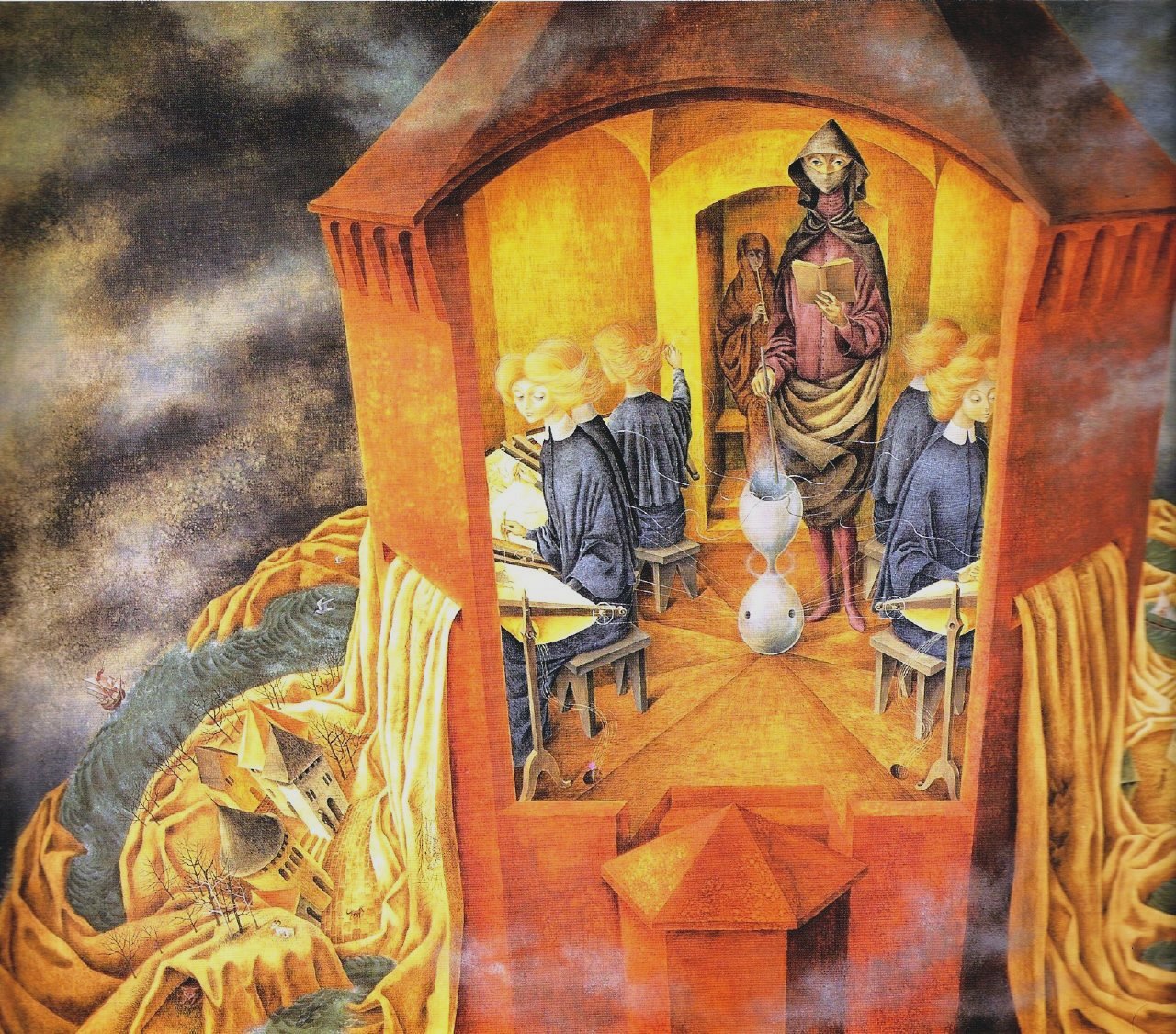
And thank you to this book for pointing me to Remedios Varo’s Bordando el Manto Terrestre. Wow!